Dharma Transcripts
Wisdom of Emptiness Retreat — Day 3: 13 August 2026
Session One — Day Three Meditation Session
13 August 2026 5:45 AM – 08:00 AM
Deer Park Institute, Bir
Meditation Session
Preliminary Practice: Reading through the important verses and texts, including the inspiring life story of Jetsun Milarepa, the great enlightened yogi of Tibet, whose principal disciple was the Venerable Gampopa.
Explanation of the Four Dharmas of Venerable Gampopa
Jetsun Gampopa was a great physician. A small account from his life recalls that his wife could not bear to leave her body, worried that if she passed away, he would marry someone else. Gampopa was highly learned and went on to become a monk, the principal student of Jetsun Milarepa, and made immense contributions to the Dharma. He taught the following four verses, which are recited to this day:
- May I be blessed that my mind is directed towards the Dharma.
- May I be blessed that my Dharma practice is on the proper path.
- May I be blessed that the path is freed of flaws.
- May I be blessed that the flaws are seen in the light of exalted wisdom.
The third verse is the most important, and the fourth represents the highest level of realization. Avoiding wrong directions due to obstacles is important, but even if one strays and encounters flaws, seeing those very flaws as illusion-like — and not being pulled by them — means they no longer function as real obstacles.
The Four Dharmas of Venerable Bhikshu Mahasattva
- Becoming utterly frustrated with the ignorance that grasps at true existence, please bless me to generate genuine renunciation, seeing all aspects of Saṃsāra as viciously repulsive.
- Please bless me that my mindstream overflows with the precious Bodhicitta that cherishes others more than myself.
- Please bless me to have an immaculate experience of the wisdom of emptiness that does not see even an atom of intrinsic reality, on the basis of understanding how things come into being through dependent origination, by mere conditioning.
- Please bless me that my mindstream overflows with the precious wisdom of the non-duality of bliss and emptiness.
IDAM GURU RATNA MANDALAKAM NIRYATAYĀMĪ
These four dharmas constitute the essence of the real Dharma. One should study and analyze how they form the road of Dharma, and practice them in pursuit of the two goals — fearlessness and infinite happiness. In summary, they represent:
- Renunciation
- Bodhicitta
- The Perfect View of Emptiness
- The Non-duality of Bliss and Emptiness (which serves to expedite the path by accelerating the cultivation of the first three)
Generating the Mind of Consummate Yoga
The purpose is to stop reactivity and cultivate proactivity. Shamatha practice serves to stop reactivity, while analytical meditation serves to increase proactivity — the highest level of which is Special Insight. This is referred to as Vipassana, though the term is used quite differently in the ten-day Vipassana course tradition compared to the Nalanda tradition. Both approaches are extremely precious.
Instructions on Shamatha Meditation
- Body Posture – The Seven-Point Posture of Buddha Vairochana
- Focal Point
- Identifying the Errors of Meditation
- Applying the Remedies
Meditation to Cultivate Renunciation
To be practiced on the basis of the Four Seals of the Buddha’s Teachings.
Meditation to Cultivate Bodhicitta (Page 365)
Two methods:
- The Sevenfold Method of Cause and Effect to Generate Bodhicitta
- The Method of Equalizing and Exchanging Self for Others to Generate Bodhicitta
Today’s Bodhicitta practice was conducted on the basis of the Four Immeasurables. These are not the actual practice of Bodhicitta itself, but serve as preliminaries to it.
Taking the Aspirational Bodhisattva Vows (Page 50)
I go for refuge to the Triple Gem;
I confess the negativities individually;
I rejoice in the virtues of all beings;
I hold the precious Buddhahood in my heart.
I go for refuge until I am enlightened
To the Buddha, Dharma and the supreme Sangha.
I generate the mind of Bodhicitta
To resolutely accomplish the aims of others and myself.
Having generated the mind of supreme enlightenment (Bodhicitta),
I invite all sentient beings to be my guests,
And shall engage in the appealing deeds of excellence of Enlightenment.
May I become a Buddha to benefit all sentient beings. (x3)
Daily Recitation and Practice (Page 50)
Gurus, Buddhas and Bodhisattvas, please pay heed to me.
Just as the previous Buddhas
Have generated the mind of Bodhicitta,
And just as they successively dwelt
In the Bodhisattva practices,
Likewise, for the benefit of all sentient beings,
I will generate the mind of Bodhicitta,
And likewise, shall I, too,
Successively dwell in the Bodhisattva practices. (x3)
Ven. Geshe-la then offered an explanation of the first verse above:
I go for refuge to the Triple Gem;
I confess the negativities individually;
I rejoice in the virtues of all beings;
I hold the precious Buddhahood in my heart.
The Bodhisattva Practices
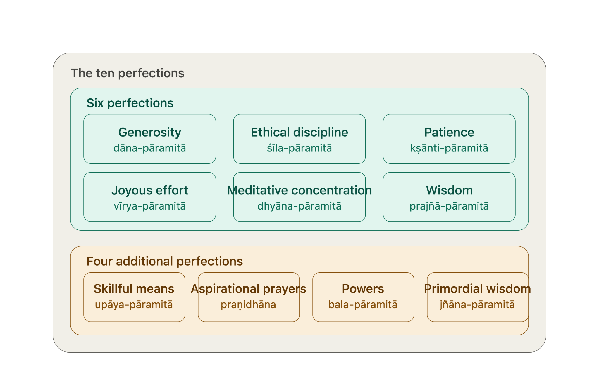
The Bodhisattva practices comprise the Six Perfections plus four additional ones, totaling ten:
- Perfection of Generosity (dāna-pāramitā)
- Perfection of Ethical Discipline (śīla-pāramitā)
- Perfection of Patience (kṣānti-pāramitā)
- Perfection of Joyous Effort (vīrya-pāramitā)
- Perfection of Meditative Concentration (dhyāna-pāramitā)
- Perfection of Wisdom (prajñā-pāramitā)
- Perfection of Skillful Means (upāya-pāramitā)
- Perfection of Aspirational Prayers (praṇidhāna-pāramitā)
- Perfection of Powers (bala-pāramitā)
- Perfection of Primordial Wisdom (jñāna-pāramitā)
The session concluded with dedication prayers.
Session One — Day Three
13 August 2026 9:00 AM – 10:30 AM
Deer Park Institute, Bir
The session began with the reading and reflection on the Thirty-Seven Practices of A Bodhisattva by Glase Thogmay Sangpo. Page 177. Ven Geshe La explained some verses and technical points to be mindful while reciting the text.
- The Four Seals of the Buddha’s Teachings:
All composite things are impermanent.
All contaminated things are of the nature of suffering.
Everything is of the nature of emptiness and selflessness
Transcending sorrow is absolute peace.
These four lines are metaphorically sealed by the Buddha. Anyone who wishes to end suffering must practice these four seals without exception.
- All composite things are impermanent:
The First Seal — Composite Things are Impermanent
Composite things, or compounded phenomena, are those composed of material or temporal parts — temporal parts meaning parts existing in time. The Buddha did not state that everything is impermanent; rather, he stated that only composite things are impermanent.
Non-composite phenomena are not impermanent — they are permanent. An example of this is the permanent phenomena other than ultimate truth that we studied earlier. Examples and their underlying reasons are to be discussed in group discussion.
The First and Last Teaching
The first and last teaching the Buddha gave was on impermanence. According to the historical account, the Buddha literally taught on impermanence at the time of his Mahāparinirvāṇa.
When one becomes a Buddha, there is no death. However, historians refer to the historical account of the Buddha’s biography. The Buddha is like the moon in the sky, while its reflection is like the moon in water — lasting only as long as the water in the container lasts. The water here is a metaphor for our karma.
Upon becoming a Buddha, one can manifest oneself infinitely, and simultaneously in different places. For example, while the Buddha was teaching the Heart Sutra in Rajgir, he was simultaneously teaching the Kalachakra Tantra in Amaravati, in South India.
The Buddha said: “Of all the footprints, the footprint of the elephant is supreme; of all the teachings of the Buddha, the teaching on impermanence is supreme.”
Reconciling Impermanence and Emptiness
“Waking up” is a metaphor for the wisdom of emptiness. Bodhisattva Shantideva said that the wisdom of emptiness is the only liberating path; all other paths serve to reinforce and support this practice.
There may appear to be a contradiction here, but there is none — the two need to be understood in context. Meditation on impermanence creates a sense of urgency, which in turn makes one’s journey toward enlightenment swift, giving rise to genuine passion for Dharma practice. With this sense of urgency established, one then needs the wisdom of emptiness to attain liberation.
Two Types of Impermanence
- Gross Impermanence: Impermanent phenomena whose continuum comes to an end.
Reflect on gross impermanence in daily life: For example, watching a video on how a family begins in a house, with happy moments and sad ones — children growing up, going to school and college, eventually leaving home — until only the parents remain in that house, and, in time, everything vanishes. Similarly, consider the metaphor of a train journey representing the journey of life — the entire cycle of birth and death.
The 4 lines that the Buddha said as teaching on Impermanence:
Recommendation for Retreat Practice
It is recommended to go on retreat and meditate on the Four Seals for one week or ten days; if time is limited, a long weekend of three days will also suffice. It is advised not to publicize one’s retreat, as doing so may actually increase afflictions – this would be counterproductive, as it feeds the ego. One should keep it low-profile, since the purpose of the retreat is to remove afflictions and awaken one’s Buddha nature, not to stop painful tears through outward recognition.
Reading reference: Dhammapada
- Subtle Impermanence: momentariness of the composite phenomena.
Permanence refers to something that does not undergo momentary change – it does not necessarily mean something lasts forever, nor does impermanence necessarily mean something is short-lived.
Something can be impermanent yet last forever — such as the mind, which changes moment to moment but continues without end.
Something can be permanent yet last for as brief as a second — such as the absence of a tiger in a room, which does not undergo change while it lasts.
Reflecting on Subtle Impermanence
One is recommended to meditate on subtle impermanence on a daily basis. This serves as an example of how one can meditate on subtle impermanence. Let’s say someone planted a Bodhi tree sapling in Deer Park, then left and returned ten years later to find it had grown into a full tree. It did not grow overnight — in reality, it was growing in every single moment, imperceptibly, all along.
Session Two — Day Three
13 August 2026 11:30 AM – 12:30 PM
Deer Park Institute, Bir
Topics Covered
- The Four Seals of the Buddha’s Teachings:
All composite things are impermanent.
All contaminated things are of the nature of suffering.
Everything is of the nature of emptiness and selflessness
Transcending sorrow is absolute peace.
These four lines are metaphorically sealed by the Buddha. Anyone who wishes to end suffering must practice these four seals without exception.
- All composite things are impermanent:
1) Gross Impermanence
2) Subtle Impermanence
Subtle Impermanence — Continued
We have been discussing subtle impermanence. Just as we observed with a timer watch, all composite phenomena are changing, or moving, at a very high speed. The next question is: where are they moving toward?
This is much like being on an airplane — if the pilot is skilled, we will land safely at a good destination; if not, the journey becomes very frightening. In our case, unfortunately, the pilot is self-grasping ignorance.
The Second Seal
All contaminated things are of the nature of suffering.
What is contamination?
Here, contamination refers to afflictions. An affliction is a mental factor whose very presence disturbs the mind. Whatever comes under the influence of affliction is therefore called contaminated, and it leads us toward misery. For example, greed, desire, and anger influence our karma, and as a result, our karma becomes contaminated — giving rise to suffering.
What is Misery?
Misery or Suffering can be understood as pain, unease of mind, not getting what one expects, fear, and a general lack of happiness. In other words, misery is a lack of freedom. For example, when we say “I like cheesecake,” this is, in fact, an expression of a lack of freedom — it is an involuntary pull towards cheesecake.
In the scriptures, ordinary beings are described as childlike, precisely because of this lack of freedom and the involuntary way in which they are being pushed and pulled by the afflictions.
Non-Composite / Permanent Phenomena
These are phenomena that are devoid of change. However, this does not mean that something must exist forever to be considered permanent. Something permanent may last for as brief as a split second, and, conversely, there are impermanent phenomena that last forever. These are simply facts – take a moment to reflect on them with the help of examples.
Examples of Permanent Phenomena:
- Non-composite space
- The ultimate truth of the mind
- The absence of a flower in your hand
Non-composite space: quality of the absence of obstruction of the composite space is the non-composite space.
Why is absence of obstruction permanent?
Discuss in group discussion sessions.
Session Two — Day Three
13 August 2026 03:30 PM – 04:30 PM
Deer Park Institute, Bir
Topics Covered
The Three Principal Aspects of the Path – Page 109
A reading and brief explanation of the Three Principal Aspects of the Path was given, as these are essential for attaining our goal:
- Wisdom of Emptiness — the only liberating path (the urgency for this is created by the first two, following motivations).
- Bodhicitta — the wish to remove the suffering of others.
- Renunciation — the wish to remove one’s own suffering.
As long as one practices these three, one remains safe and is working well toward genuine well-being. In which tradition, it does not really matter.
If someone were to ask you to practice these, three natural questions would arise:
- Why should I practice this?
- How do I practice this?
- What is the measure, or sign, of having generated it — such as the wisdom of emptiness?
Lama Tsongkhapa addresses all three of these questions, with respect to each of the three aspects, in this text.
Wisdom of Emptiness — Verse 9 (Why?), 10, 11 (How?) and 12 (Measure), 13 Additional Point, 14 (Benefit of Practicing 3 Prncipal Aspects of Path)
Bodhicitta — Verse 06 (Why?), 07 (How?) and Measure is just implicitly there,
Renunciation — Verse 03 (Why?), 04 (How?) and 05 (Measure)
Composite space and Non-composite space
Composite space: The space which my eyes can validly see.
Non-composite space: the quality of the absence of obstruction of the composite space is the non-composite space.
On the Absence of a Flower in the Hand – Permamnent Phenomena
When asked whether my hand, having an absence of a flower, therefore has “something” in it, there is an interesting inconsistency between how a philosopher might respond and how someone unexposed to philosophy might respond.
Philosophically, one would say yes — something is there, because the absence of the flower is present. However, an ordinary person would say no — nothing is there, because there is nothing tangible or substantial in the hand. Both responses are, in fact, correct, but they operate from different standpoints.
For the ordinary person, for something to be considered “there,” it must possess substance. From this, it follows that since the absence of the flower has no substance, they say nothing is there.
Thus, the absence of the flower in my hand does exist, but it is devoid of substance. For something to undergo change, it must possess substance capable of changing — and since the absence of the flower has no substance, it cannot undergo change. Therefore, since the absence of the flower does not undergo change, it is not impermanent. It is, instead, a permanent phenomenon.
Any absence is a permanent phenomena.
Isolates of a Phenomenon
Just as the flower has many isolates — the absence of chocolate, the absence of a mango, and so on — likewise, composite space also has multiple isolates. For instance, composite space has no chocolate, and it also lacks obstruction.
The absence of obstruction with respect to composite space is what is called non-composite space.
Three Types of Suffering
- Suffering of Suffering
- Suffering of Change
- Pervasive Conditioned Suffering
1) Suffering of Suffering
This refers to any evident suffering that no one likes — pain that is universally recognized as suffering.
2) Suffering of Change
This refers to mundane, or worldly, happiness. The question then arises: how is this happiness actually a form of suffering, and why is the word “change” added to its name? This was illustrated through the anecdote of a lady in a rented place, as well as the example of two prisoners.
3) Pervasive Conditioned Suffering
To be continued tomorrow…
Continue exploring
The same ground, in other forms
Related by topic rather than by format — which is how a transcript, a diagram and a guided meditation on emptiness find each other.
Śamatha Meditation on the Breath
Calming the mind and cultivating stability and clarity: posture, focal point, the two common errors of meditation, and their antidotes.…
Why Meditate With the Eyes Open
A short teaching by Ven. Geshe Dorji Damdul.
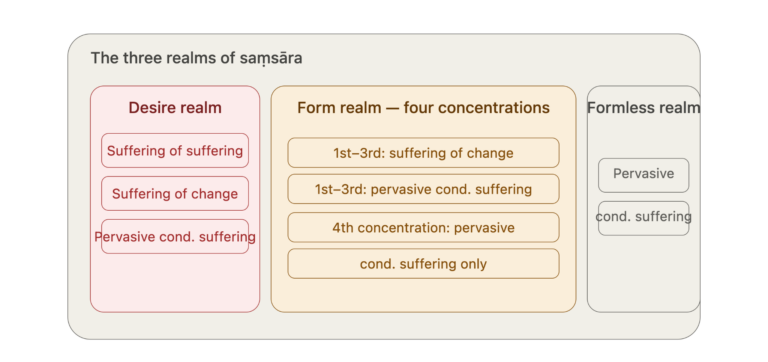
Which Suffering Exists in Which Realm
Suffering of suffering: Present only in the Desire Realm. Suffering of change: Present in the Desire Realm, as well as…
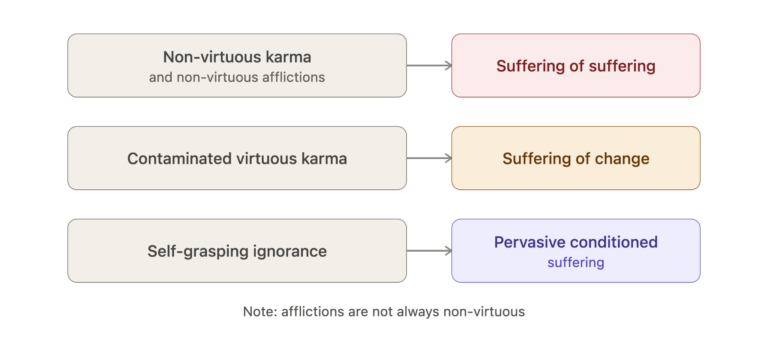
The Immediate Causes of the Three Types of Suffering
**Immediate Cause of Suffering of Suffering: Non-virtuous karma and non-virtuous afflictions. (Note: afflictions may not always be non-virtuous.) **Immediate Cause…