Dharma Transcripts
Wisdom of Emptiness Retreat — Day 7: 17 August 2026
Session One — Day Seven Meditation Session
17 August 2026 05:45 AM – 08:00 AM
Deer Park Institute, Bir
Prayers and Practice
Generating the Mind of Consummate Yoga
Session Two — Day Seven
17 August 2026 09:00 AM – 10:30 AM
Deer Park Institute, Bir
Topics Covered:
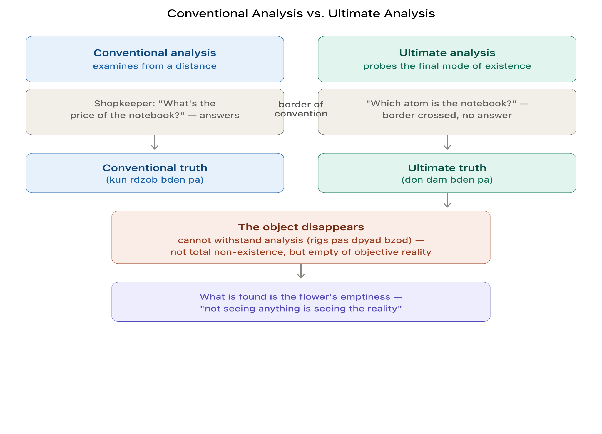
In Buddhist philosophy, particularly within the Nalanda tradition, the investigation of reality is conducted through two modes of inquiry: conventional analysis (tha snyad dpyod byed kyi tshad ma) and ultimate analysis (don dam dpyod byed kyi tshad ma).
1. Basic Definitions
- Conventional Analysis (tha snyad dpyod byed kyi tshad ma): This is the mind that “examines the object, but not so closely” and perceives things “from a distance” as they appear in the everyday world. It operates within the “border of conventionality” and validates objects like flowers, houses, and persons based on worldly norms.
- Ultimate Analysis (don dam dpyod byed kyi tshad ma): This is the mind which “very closely examines the object” and “goes closer towards the object” to investigate its “final mode of existence” or “mode of subsistence” (sdod lugs). It probes whether an object exists “objectively” (rang ngos nas grub pa) or “from its own side”.
2. The Demarcation (Crossing the Border)
The “border of conventionality” is the point where ordinary worldly inquiry ends and philosophical probing begins.
- Inquiry beyond the name: While conventional analysis is satisfied with the label “flower,” ultimate analysis asks, “Where is the flower? The petal is the flower? Or the cells are the flower?”.
- The Shopkeeper Analogy: A shopkeeper deals with the “conventional reality” of a notebook; if you ask for the price, he can answer. However, if you ask which atom is the notebook, “you have crossed the border of conventionality” into “the ultimate domain,” and the shopkeeper is left with no answer because his mind is limited to conventional analysis.
- Logical Entailment: “The moment you cross the border of conventionality, you plunge into the ultimate analysis”.
3. Relationship to the Two Truths
The two analyses are the “two frames of reference” that establish the Two Truths (bden pa gnyis).
- Conventional Truth (kun rzob bden pa): This is the “object found by a valid cognition which analyzes conventions”. “An object which is found by the valid conventional analysis is known as conventional truth”.
- Ultimate Truth (don dam bden pa): This is the “object found by the valid cognition analysing the ultimate”. The “truth seen by the valid ultimate analysis is known as ultimate truth”.
4. Findings and “Withstanding” Analysis
The primary difference between the two analyses lies in whether the object “disappears” under scrutiny.
- Non-Findability: “The moment you subject the flower to ultimate analysis… the flower disappears”. This “disappearance” does not mean the object is totally non-existent, but that it is “empty of objective reality”.
- Withstanding Analysis (rig pas dpyad bzod): Conventional entities cannot withstand ultimate analysis. “If the flower does exist objectively, ultimate analysis should be able to find the flower. If it finds it, the object withstands the ultimate analysis”. Since it is not found, it fails to withstand scrutiny.
- Ultimate Truth as Findings: While ultimate analysis cannot find a “flower,” it finds the Emptiness of that flower. Therefore the Buddha said, “Not seeing anything [objectively] is seeing the reality or seeing the supreme”.
5. Differing Perspectives of Madhyamaka Schools
The sources distinguish between the Prasangika (thal ’gyur pa) and Svatantrika (rang rgyud pa) views on where the “border” of ultimate analysis lies:
- Prasangika Perspective: Ultimate analysis begins the moment one is “unsatisfied with conventional designations” and asks if a sprout arises from itself or another. Simply looking for the “referent of the designation” constitutes probing into suchness.
- Svatantrika Perspective: Merely inquiring into “self or other” does not constitute ultimate analysis; for them, it only becomes an inquiry into suchness when one analyzes whether something exists “by virtue of its own objective mode of being” and “not posited in dependence on the object’s appearance to the mind”.
Points: Reasoning of the Four Essentials to Establish Emptiness
- If the flower exists objectively, it should be findable through ultimate analysis.
- What ultimate analysis reveals is that there are only two possibilities: either the atoms are the flower, or they are different from the flower.
- Neither of these two ways is the flower found to exist.
- Therefore, by pervasion, one realizes that the flower does not exist objectively. It is empty of objective existence.
Instruction on the Meditation on Emptiness of Flower:
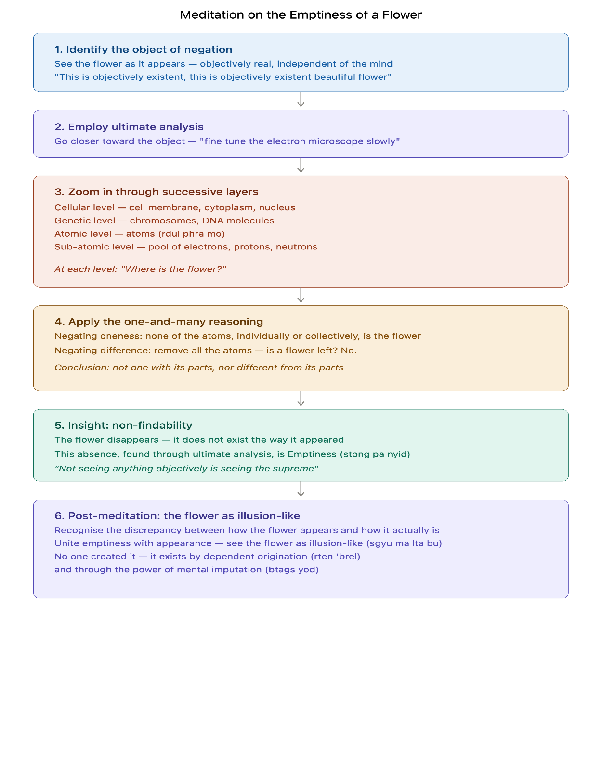
The instructions on the Meditation on the Emptiness of a Flower involve a systematic investigative process using ultimate analysis (don dam dpyod byed kyi tshad ma). Based on the exact words of the sources, the meditation is structured as follows:
1. Identifying the Object of Negation (dgag bya ngos ‘dzin pa’i gnad)
The first step is to clearly identify the “true existence” or “intrinsic existence” (rang bzhin gyis grub pa) of the flower. The Buddha taught in Upali Requested Sūtra [Skt. upālipariprccha nāma mahāyāna sūtra, Tib. nye bar ’khor gyis zhus pa zhes bya ba theg pa chen po’i mdo], available on Page 255, The Blaze of Non-dual Bodhicittas.
“The various delightful flowers blossom
And the sparkling supreme golden abodes stand so alluring.
For none of these is there a creator.
They are posited by the power of thought.
It is through conceptualisation that the world is imputed.”
- The Visualization: Observe the flower as it undeniably appears to the mind: “the flower appears objectively real… that you see the flower as independent of the subject, of your mind”.
- The Mode of Grasping: “You see the flower, and you see it as ‘this is objectively existent flower, this is objectively existent beautiful flower'”. One must identify this “objective existence” as something believed to be “100% from the object”.
2. Employing Ultimate Analysis (don dam dpyod byed kyi tshad ma)
To investigate this objective reality, one must “employ the reasons to see whether the flower actually exists from the object side or not”.
- Going Closer: This involves “going closer towards the object” or “zooming in”.
- Mental Dissection: The practitioner is instructed to mentally “fine tune the electron microscope slowly”.
3. The “Zooming In” Process of Ultimate Analysis (Levels of Subtlety)
The analysis moves through increasingly subtle layers of the flower’s constituents:
- Cellular Level: First, “cracks would be seen… the cell membrane will be visible… the cell membrane, the nucleus and cytoplasm will be visible”.
- Genetic Level: Within the nucleus, “you will start seeing the chromosomes… they are also nothing but made of the DNA molecules”.
- Atomic Level: “Then through further fine tuning we see that even these DNA molecules are made up of atoms” (rdul phra mo).
- Sub-atomic Level: Finally, one reaches the level of “seeing just the pool of billions of atoms… electrons, protons and neutrons”.
4. Applying the “One and Many” Reasoning
At this level, the practitioner applies the Reasoning of the Four Essentials (gnad bzhi) to find the “objective flower” among its parts:
- Negating Oneness (gcig bral): “You look into the constituents, the parts, and ask, ‘Where is the flower?’… none of the atoms is the flower”. “Neither the individual parts… nor the collection of the parts as the bearer of the parts is also the flower”.
- Negating Difference (du ma bral): One asks if the flower exists “objectively different from these parts”. The logic is: “remove the atoms… is there a flower left?… No”.
- Conclusion: “The flower is not objectively one with the parts nor different from its parts”.
5. Reaching the Insight: Non-Findability
Through this close scrutiny of ultimate analysis, the flower fails to withstand analysis:
- Disappearance: “The moment you go too close to this object then the flower disappears… the flower disappears means it does not exist the way it appeared.”.
- Discovery of Emptiness: “That absence of flower in the context of the ultimate analysis, that is known as Emptiness” (stong pa nyid). “Not seeing anything [objectively] is seeing the supreme, seeing the ultimate”.
6. Post-Meditation: Seeing the Flower as Illusion-like (sgyu ma lta bu)
Upon emerging from meditation, the practitioner integrates the two truths:
- Discrepancy: Recognise the “disparity between the way the thing actually is and the way it appears”.
- The Union: “Combining the two moments together… meditative experience of the Emptiness and the post meditative experience of the appearance of objective existence… you see things as illusion like”.
- Dependent Origination: Realise the flower “nobody created… it is my mind which created this flower” through the power of mental imputation (btags yod). “It exists by power of dependent origination (rten ‘brel)… only with imputation, the flower as a whole comes into being”.
Question: what exactly is cognitive obscuration?
Based on the sources, cognitive obscuration (Sanskrit: jñeyāvaraṇa; Tibetan: shes bya’i sgrib pa or shes sgrib), also referred to as obscuration to knowledge or obscuration to omniscience, is the subtle layer of mental defilement that remains after the primary afflictions have been uprooted.
Definition and Nature of Cognitive Obscuration
The sources provide several precise definitions and characteristics:
- The Subtle Defilement: It refers to “subtle defilements [that] obstruct us from achieving total Enlightenment or Buddhahood” and the “total awakening of Buddha Nature within ourselves”.
- Obstacle to Knowledge: It “constitutes the obstacle to thorough comprehension of the object of knowledge,” meaning it “stops you for cognizing all phenomena simultaneously”.
- Residual Latencies (bag chags): It is defined as “obscurations that are in the form of residual imprints—which are distinct from seeds”. Specifically, it consists of “the latencies that are not seeds of the afflictions”. While an “active seed” (sa bon) germinates into a full affliction like anger, these “non-seed latencies” or “inactive seeds” are the subtle stains that persist even in Arhats (dgra bcom pa).
- The Garlic Analogy: The sources illustrate this using a drinking vessel: “Subtle stains are like smell of garlic that remains even after every atom of solid garlic has been removed”. The “solid garlic” represents afflictive obscurations, while the lingering “smell” represents cognitive obscurations.
The Result: Mistaken Dualistic Appearance
The primary effect of cognitive obscuration is the persistence of mistaken dualistic appearance (gnyis snang ‘khrul ba):
- Objectified Appearance: It causes things to “appear as truly real, objectively real” (rang ngos nas grub pa).
- Dualism as Symptom: “Included within this class of obscurations are all the facets of deluded dualistic perceptions… which are the effects of those habitual propensities”.
- Blockage of Omniscience: Because the mind “gets stuck with the appearance” of objective existence, these obscurations “obstruct you from becoming the omniscient”.
The Snow Analogy in Detail
The sources use the snow analogy (often involving Mount Kailash) to explain how cognitive obscuration functions as a “concealer” (kun rzob) that distorts reality despite one’s intellectual knowledge.
- The Blue Goggles (mig shel sngon po): “When you put on the blue glasses and somebody knows that snow is white… you will see the snow mountain appears as blue”.
- The Jaundice Case (mig ser): “Group A suffers from severe jaundice… and group B is free of jaundice problem. You look at Mount Kailash, and group A will see this as a yellow Mount Kailash and group B will see this as a white Mount Kailash”.
- Appearance vs. Engagement: To the person wearing blue goggles, there is an “error pertaining to the appearance” (mistaken mind) but if they know the snow is white, they do not “engage” or “agree with the appearance” (deceptive mind).
- The Status of Arhats: The sources compare Arhats to people who have removed their goggles but still have “taints in the form of residual imprints”. Where the “common people see things like the blue snow with their blue glasses on, the Arya beings (’phags pa) see the snow as white with their very clear eye sight”.
- Intermittent Experience: For Arhats, these appearances “occur intermittently”. In “meditative equipoise” (mnyam bzhag), dualistic appearances “vanish” and they see suchness (de bzhin nyid), but in “subsequent attainment” (rjes thob), “mental states are once again tainted by the imprints of ignorance,” causing things to appear objectively real again.
Critical Details and Tenet Distinctions
- Abandonment Point: These obscurations “cease for the omniscient and the buddhas alone”. According to the Prasangika system, they are not even touched until the “eighth ground” (sa brgyad pa) and are fully eliminated only at Buddhahood.
- Prasangika vs. Lower Schools: In lower systems (Chittamatra and Svatantrika), “grasping at the selfhood of phenomena” (chos kyi bdag ‘dzin) is classified as a cognitive obscuration. However, the Prasangika tradition maintains that “all instances of grasping at self existence… are forms of afflicted ignorance,” and cognitive obscurations are strictly the “residual imprints” left behind by that grasping.
- Efficacy: Even though these distorted appearances (like “blue snow”) are “purely subjective” and “non-existent,” they are not random “imagination”. They have “efficacy” (don byed nus pa)—for instance, put on pink glasses, and you will see pink snow, showing that “under particular conditions you only see [a specific] hair falling and not the other non-existent things”.
Five Paths to Enlightenment
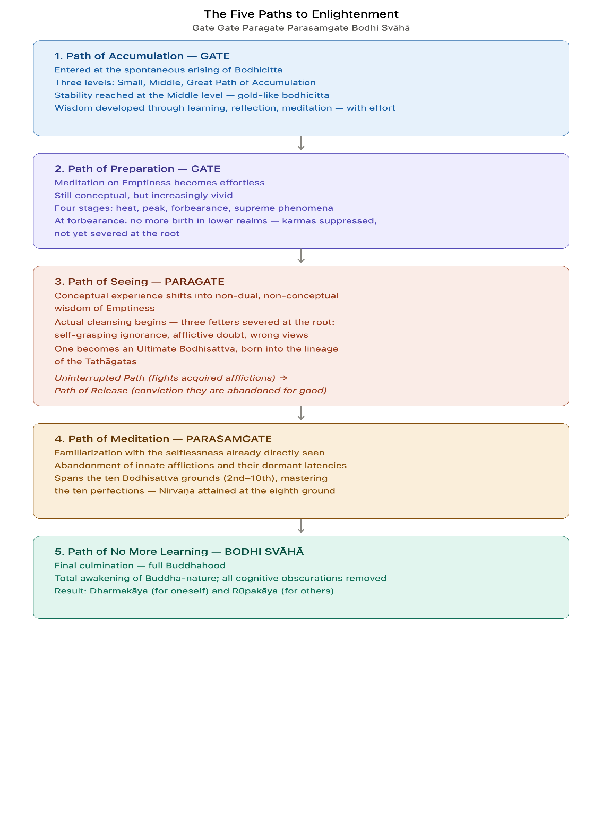
Based on the sources, the Five Paths to Enlightenment (GATE GATE PARAGATE PARASAMGATE BODHI SVAHA) are described as a “journey of cleansing the mind” that takes a practitioner “from a state of impurity to a greater state, state of greater purity… and eventually to the greatest purity”.
The exact names and definitions of the five paths are as follows:
1. Path of Accumulation (GATE)
- Entrance Mark: “One enters into the first GATE the moment the mind has a spontaneous experience of Bodhicitta—’May I become a Buddha for the benefit of all sentient beings'”.
- Levels: It is divided into three levels: The Small Path of Accumulation, The Middle Path of Accumulation, and The Great Path of Accumulation.
- Stability: “Only when we reach the second—The Middle Path of Accumulation—are you guaranteed that you will not fall back. Your Bodhicitta becomes very stable and is called gold-like bodhicitta”.
- Wisdom: It involves the wisdom derived through learning, reflection, and meditation performed “with effort”.
2. Path of Preparation (GATE)
- Entrance Mark: “When meditation [on Emptiness] becomes effortless, it moves to the Path of Preparation”.
- Experience: It remains a conceptual experience of Emptiness, though it becomes increasingly vivid. At the final level, it is so vivid “that the person feels that ‘I’m seeing Emptiness directly'”.
- Four Stages: Its qualities are “Heat, peak, forbearance, and then the supreme of the phenomena”.
- Forbearance (zoepa): At the third level (forbearance), one is “guaranteed not to take birth into the lower realms” because contaminated karmas are suppressed, though not yet “severed from the root”.
3. Path of Seeing (PARAGATE)
- Entrance Mark: This stage begins when the effortless conceptual experience “change[s] into non-dual wisdom, non-conceptual Wisdom of Emptiness“.
- Actual Cleansing: “The final cleansing, actual cleansing starts from the Path of Seeing“. Here, the “three fetters of bondage”—self-grasping ignorance, afflictive doubt, and wrong views—are “severed from the root”.
- Status: A practitioner on this path is known as an Ultimate Bodhisattva and is “born into the lineage of the Tathagatas”.
- Stages within the Path:
- Uninterrupted Path (bhar chay may lam): The stage where one “fights the set of afflictions which are acquired” and throws them out.
- Path of Release (Nam drol lam): The stage where one has “locked the door” and has the conviction that acquired afflictions are “abandoned for good”.
4. Path of Meditation (PARASAMGATE)
- Function: It is a process of “familiarization with the selflessness of the person” and phenomena that has already been directly seen.
- Purification: It involves the abandonment of innate afflictions and the “subtle smells” or “dormant latencies” of ignorance.
- The Ten Grounds (Bhūmis): This path encompasses the majority of the ten Bodhisattva grounds (from the second to the tenth) where one gains expertise in the ten perfections.
- Nirvana: According to the Prasangika system, one attains Nirvana (freedom from all afflictions) upon reaching the eighth ground within this path.
5. Path of No More Learning (BODHI SVAHA)
- Definition: This is the “final culmination of your goal—the goal of Enlightenment” or Buddhahood.
- Full Awakening: It represents the “total awakening of Buddha Nature within ourselves” and the final state of purification where all cognitive obscurations are removed.
- Result: One achieves the two goals: the Dharmakaya (for oneself) and the Rupakaya (for the benefit of others).
Session Three — Day Seven
17 August 2026 11:30 AM – 12:30 PM
Deer Park Institute, Bir
The verse you provided is the opening salutation of Arya Nagarjuna’s (’phags pa klu sgrub) principal work, the Mûlamadhyamakakārikā (dbu ma rtsa ba shes rab). This verse is considered the “distilled essence of the mind of the sugatas of three times” and a “summary of the whole body of the text”.
In dependent origination,
There is no ceasing, no arising,
No annihilation, no permanence,
No coming, no going,
No separateness and no sameness.
I prostrate to the consummate Buddha,
The supreme among all teachers,
The one who taught (this) peace,
Which is free of elaborations.
1. The Nature of Dependent Origination (rten ’brel)
The verse establishes that because things are dependently originated, they are “utterly free of intrinsic nature”.
- The King of Reasonings: This is the “peerless reason to ascertain Emptiness” and is “hailed” as the method to avoid the “dreadful abyss” of extremes.
- The Three Levels: It functions on three levels: causal (results depending on causes), structural (wholes depending on parts), and the subtlest level (dependence on mere mental designation or btags yod).
- A “Great Wonder”: Arya Nagarjuna declares that understanding this Emptiness while also conforming to the “law of karma (las) and its results” is “more wondrous than wondrous”.
2. The Eight Negations (Rejecting the Eight Extremes)
The verse rejects eight specific extremes that constitute “wrong views” and “reifications” (sgro ‘dogs). These negations demonstrate that “nothing anywhere ever possesses arising at all” in an objective sense.
- No Ceasing, No Arising: This rejects intrinsic production and disintegration. “What is produced from conditions is unproduced” because it lacks a “self-powered entity”.
- No Annihilation, No Permanence:
- Annihilation (chad lta): Rejection of the view that causes and effects are “intrinsically other” and thus “unrelated,” which would mean the continuum stops.
- Permanence (rtag lta): Rejection of the “view of permanence which superimposes inherent existence” or the belief that a cause must remain present and unchanged when the effect exists.
- No Coming, No Going: This indicates that nothing “travels from one life to another” or “comes from anywhere” because phenomena are “devoid of inherent existence”.
- No Separateness, No Sameness: This refutes that the “producer and the produced” (cause and effect) are either “intrinsically different” or “identical”.
3. Peace Freed of Elaborations (spros bral)
The “Peace” taught by the Buddha refers to the “absolute peace” of Nirvana (mya ngan las ‘das pa).
- Defining Elaborations (spros pa): These are the “signs” (mtshan ma) and “diverse perceptions” that indications “I am intrinsic existence by myself”.
- The Experience of Peace: When a practitioner “sees the true nature… all this agitation, sorrow stops”. The “dualistic appearance dissolves” in the “vast expanse” of the reality.
- Primordially Tranquil: The Buddha declared all phenomena to be “primordially tranquil” (gzod ma nas zhi ba) because they have no “intrinsic arising at any time”.
4. Prostration to the Consummate Buddha
The Buddha is praised as the “Supreme among all teachers” because he “saw Dependent origination and taught it”.
- The Reliable Guide: He is the “consummate Buddha” who “eliminated the web of conceptualisations” and “dispel[led] all perverted views”.
- The Ultimate Insight: The Buddha taught that “not seeing anything [objectively] is seeing the supreme,” which is the “only panacea to heal the pains” of all sentient beings.
Summary Equation
The sources explain that these points boil down to a “comprehensive picture of how to be wisely kind towards oneself”. By seeing that “emptiness arises in the form of cause and effect,” one is “not captivated by the view of extremes”.
Explanation of the The Wheel of Life (srid pa’i ‘khor lo)
The Twelve Links of Dependent Origination
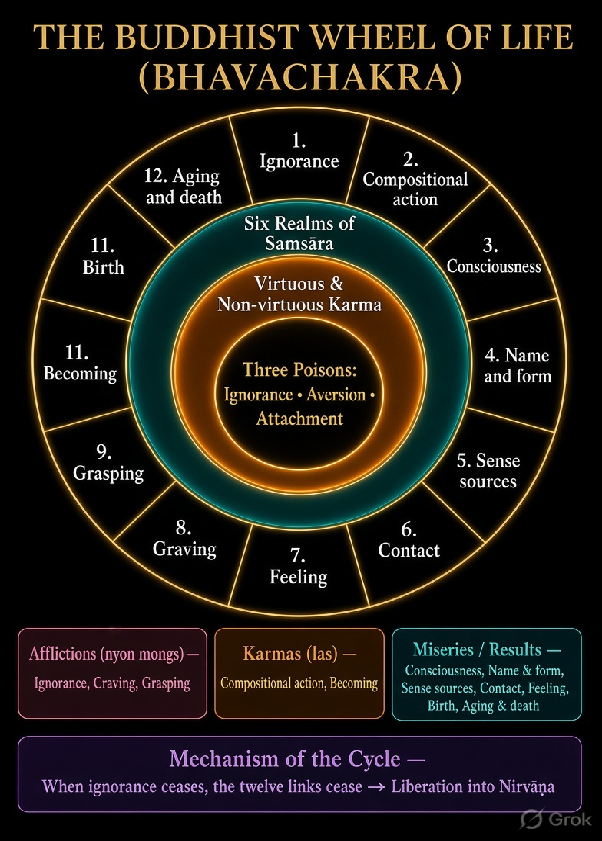
The Wheel of Life (srid pa’i ‘khor lo) is “precisely, the teaching on The Twelve Links of Dependent Origination (rten ’brel yan lag bcu gnyis)”. It is depicted as a wheel held in the claws of a “demon,” which “depicts impermanence of our death” and signifies that “as long as we are in this wheel there is no escape”.
The Structure of the Wheel
Based on the sources, the Wheel consists of four concentric circles:
- The Innermost Circle: Depicts the three poisons: “The pig symbolizes ignorance (ma rig pa). The snake symbolizes aversion (zhe sdang). The bird symbolizes attachment (‘dod chags)”.
- The Second Circle: Half white and half black, depicting “virtuous karmas (dge ba’i las) and non-virtuous karmas (mi dge ba’i las)”.
- The Third Circle: Depicts the “six migrating beings” (‘gro ba rigs drug) across the higher and lower realms of Samsara.
- The Outermost Circle: Depicts the Twelve Links of Dependent Origination.
The Twelve Links (rten ’brel yan lag bcu gnyis)
The Twelve Links are “grouped into three sets”: the set of afflictions (nyon mongs), the set of karmas (las), and the set of miseries or results (sdug bsngal).
I. The Set of Afflictions (nyon mongs kyi phung po)
- 1. Ignorance (ma rig pa): “Ignorance means that we see things as objectively real (rang ngos nas grub pa)”. It is like being “sucked into a dream” and seeing the “dream as real”.
- 8. Craving (sred pa): Depicted as a “person who is drinking alcohol.” It arises “when we are closer towards the stage of dying” as a “craving to live long, not to die”.
- 9. Grasping (len pa): Depicted as a “monkey eating one fruit and reaching out for the next.” It is the “intensification of craving”.
II. The Set of Karmas (las kyi phung po)
- 2. Compositional Action/Karma (‘du byed kyi las): Symbolised by a “potter making pots.” Just as a potter decides the shape of a pot, “what decides our next life? That is determined by our karmas”.
- 10. Becoming/Existence (srid pa): Depicted by a “pregnant woman.” “Grasping is like water to germinate a seed.” When the seed of karma (Link 2) is “germinated” by craving and grasping, it becomes “becoming,” which is on the “verge to give rise to the first shoot”.
III. The Set of Miseries/Results (sdug bsngal gyi phung po)
- 3. Consciousness (rnam par shes pa): Depicted by a “monkey jumping from one tree to the next.” The trees symbolize “the two bodies of this life and the next life.” Consciousness “moves from one body to the body of the next life” carrying all “mental imprints (bag chags)”.
- 4. Name and Form (ming dang gzugs): Depicted by “two persons in a boat.” The mind (from past life) and the body (from parents) are “trapped in the same boat called as the I”.
- 5. Sense Sources (skye mched drug): Depicted by a “house with five or six windows.” This is the process in the womb where “sense organs like eyes and ears become prominent”.
- 6. Contact (reg pa): Depicted by a “couple kissing.” It is the “mere touch of sense sources with objects”.
- 7. Feeling (tshor ba): This is when a child “could actually feel the pleasantness”.
- 11. Birth (skye ba): “Your mind is ejected from this body and connects to the next birth.” It is the “first moment of conception in the mother’s womb, in the next life”.
- 12. Aging and Death (rga shi): “We are all aging. Aging or death”. It is the “cessation of the final consciousness”.
The Mechanism of the Cycle
- Forward Order: “Conditioned by ignorance (ma rig pa), there is volition (‘du byed)”. This “forward order” describes how “the aggregate of suffering, the tree of suffering” is established.
- Causation: “Self-grasping ignorance of the phenomena gives rise to self-grasping ignorance of person and this gives rise to the remaining twelve links”.
- Cessation: The Buddha taught that “when the ignorance ceases the twelve links cease”. “If you exterminate the whole remaining twelve links… you will be freed from Samsara and you will take birth in the purity of Nirvana”.
- Key Insight: The Wheel illustrates that while “no phenomenon whatsoever transfers from this world to the next,” “death-transference and birth do manifestly exist” through the power of Dependent Origination (rten ’brel).
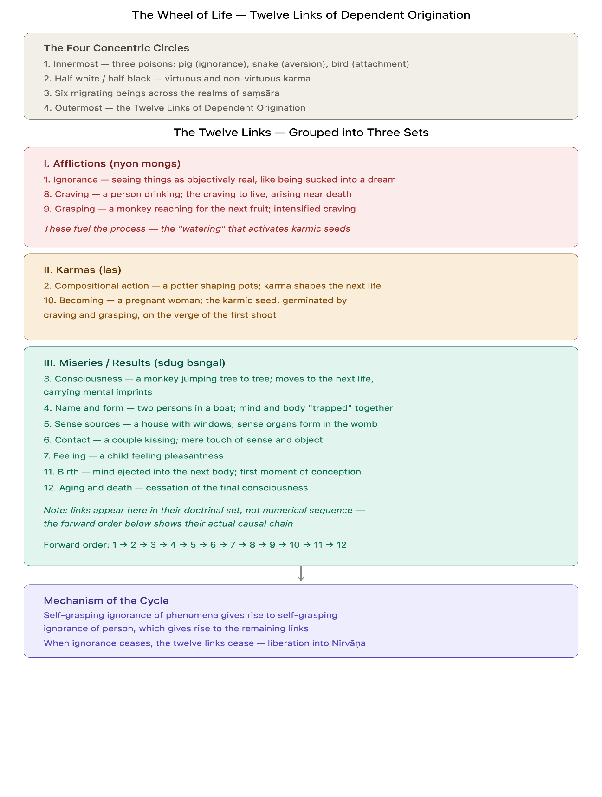
The Wheel of Life (srid pa’i ‘khor lo) is a visual representation of the Twelve Links of Dependent Origination (rten ’brel yan lag bcu gnyis), showing how sentient beings are “trapped into the vicious cycle of Samsara” and “never let go free from the pains”. The wisdom of emptiness (stong pa nyid kyi shes rab) acts as the “final antidote” to reverse this cycle by “exterminating the root”.
How the Wisdom of Emptiness Reverses the 12 Links
The reversal of the twelve links is known as the cessation order (‘gog lugs). The sources explain the mechanism as follows:
- Cutting the Root: All twelve links are “triggered by ignorance” (ma rig pa). Self-grasping ignorance is the “immediate cause of inappropriate attention,” which leads to afflictions and karma.
- The Chain Reaction of Cessation: The Buddha taught that “when the ignorance ceases, the twelve links cease”. The process is described as: “Through seeing reality one knows well that things are empty… ignorance does not arise. That is the cessation of ignorance, whereby the twelve links cease”.
- Resulting in Nirvana: By realizing that things are “empty of objective existence” (rang ngos nas grub pa med pa), the “involuntary pull and push” of attachment and aversion stops. As the sources state: “If you exterminate the whole remaining twelve links… you will be freed from Samsara and you will take birth in the purity of Nirvana”.
The reverse order of the Cycle of the Twelve Links of Dependent Origination (rten ’brel yan lag bcu gnyis) describes the process of cessation (’gog pa), which leads to Nirvana (mya ngan las ‘das pa) and freedom from the “heap of miseries”,.
According to the sources, the Buddha taught that “when the ignorance ceases, the twelve links cease”,. The exact sequence of the reverse order (cessation order) is as follows:
Cessation of Ignorance (ma rig pa): When one realizes the wisdom of emptiness and “sees the truth,” one is “confused no more” and ignorance stops,.
Cessation of Compositional Action/Karma (’du byed): When ignorance ceases, “the karma ceases” or “volition ceases”,,.
Cessation of Consciousness (rnam par shes pa): When karma ceases, “consciousness ceases”,.
Cessation of Name and Form (ming dang gzugs): When consciousness ceases, “name and form ceases”.
Cessation of Sense Sources (skye mched drug): When name and form cease, “the sources cease”.
Cessation of Contact (reg pa): When the sense sources cease, “contact ceases”.
Cessation of Feeling (tshor ba): When contact ceases, the link of feeling stops.
Cessation of Craving (sred pa): The cessation of feeling leads to the cessation of craving.
Cessation of Grasping (len pa): When craving is stopped, grasping ceases.
Cessation of Becoming/Existence (srid pa): When grasping ceases, becoming or “existence” ceases,.
Cessation of Birth (skye ba): “When the birth ceases,” it prevents the next moment of conception in a mother’s womb.
Cessation of Aging and Death (rga shi): “When the ageing and death ceases then the confusion, the bewilderment, all the heap of miseries cease”.
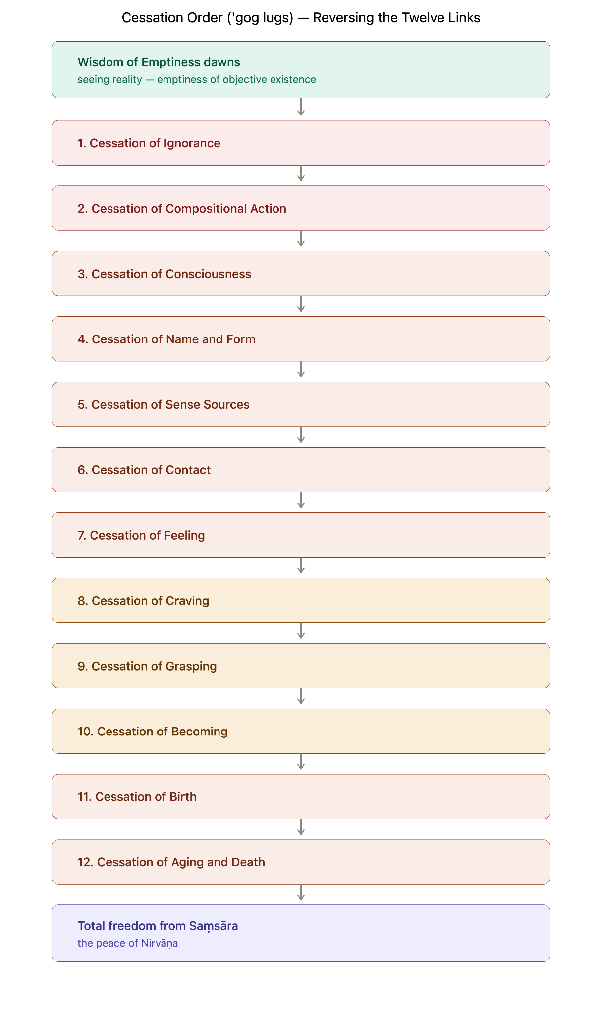
Ultimately, this reverse order represents the “actual cleansing” and the “total freedom from all fears of Samsara”,. By “exterminating the whole remaining twelve links” through the cessation of ignorance, a practitioner is “freed from Samsara” and takes “birth in the purity of Nirvana”.
How the Wheel of Life Depicts the Four Noble Truths (‘phags pa’i bden pa bzhi)
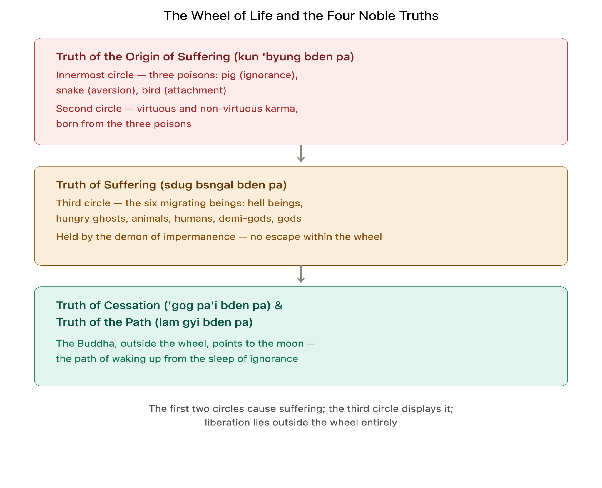
The Wheel of Life is structured into four concentric circles that map directly to the Four Noble Truths:
- Truth of the Origin of Suffering (kun ‘byung bden pa):
- Innermost Circle: Depicts the “three poisons” or “afflictions” (nyon mongs): “The pig symbolizes ignorance (ma rig pa). The snake symbolizes aversion (zhe sdang). The bird symbolizes attachment (‘dod chags)”.
- Second Circle: Half white and half black, depicting “virtuous karmas” (dge ba’i las) and “non-virtuous karmas” (mi dge ba’i las). These “two inner circles give birth to the third circle”.
- Truth of Suffering (sdug bsngal bden pa):
- Third Circle: Depicts the “six migrating beings” (‘gro ba rigs drug)—hell beings, hungry ghosts, animals, humans, demi-gods, and gods—where they “experience miseries”.
- The Demon: The whole wheel is held in the claws of a demon, which “depicts impermanence of our death,” signifying that as long as we are in this wheel, “there is no escape”.
- Truth of Cessation (‘gog pa’i bden pa) and Truth of Path (lam gyi bden pa):
- These are represented by the Buddha pointing towards a moon (the goal of Nirvana) outside the wheel, indicating that liberation is achieved by following the path to “wake up” from the “sleep of ignorance”.
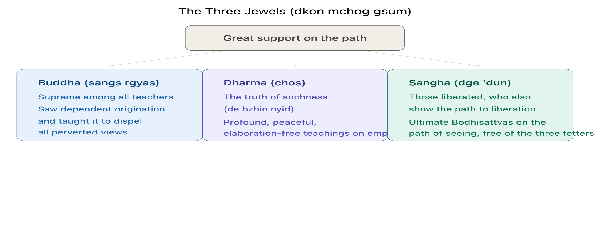
Relation to the Three Jewels (dkon mchog gsum)
The practice involves seeking “great support” from the Three Jewels to traverse the path to Enlightenment:
- The Buddha (sangs rgyas): The “consummate Buddha” is the “supreme among all teachers” because he “saw Dependent origination and taught it” to “dispel all perverted views”.
- The Dharma (chos): Specifically refers to the “truth of suchness” (de bzhin nyid) and the “profound, peaceful, elaboration-free” teachings on emptiness.
- The Sangha (dge ‘dun): Those “liberated and also show the path to liberation,” particularly the Ultimate Bodhisattvas on the path of seeing (mthong lam) who have “ridded themselves of the three fetters of bondage”.
The Commissioning of the Painting
Regarding the origin and commissioning of the painting, the sources provide the following details:
- Advice of the Buddha: It is explicitly stated that “this painting came into being on the advice of Buddha Shakyamuni himself”.
- Symbolism of the Demon: The Buddha commissioned the wheel to be depicted as being “held in the claws of a demon,” which “depicts impermanence of our death” and signifies that “as long as we are in this wheel there is no escape”.
- The Five Parts: The painting is also known as the “painting with five parts,” which refers to the “five realms” of rebirth: the “hell realm, the hungry ghost realm, the animal realm, the human realm and the god [and demi-god] realm”.
- Purpose of the Instruction: The Buddha intended the painting to provide “very beneficial instruction about how our emotions work or how we are dragged into Samsara and how we can possibly come out”.
Related Anecdote: The King and the Painter
While the sources mention that “the story” of the Wheel’s origin is generally well-known to the audience, they recount a specific anecdote involving a “king and his painter” to illustrate how sentient beings are deceived by such images and mental projections:
- The Commission: A king invited an expert painter to paint an image; the painter created a “picture of the ghost/Daemon” so meticulously that it appeared “so real”.
- The Deception: Two years later, the same painter returned to the room, saw his own work, and “came out crying with fear… saying that there is ghost there”.
- The Realisation: The painter had “forgotten that it was his own painting” and mistook his “subjective skill” for a “real ghost” coming from the object side.
- The Lesson: This anecdote serves to explain how the “self-grasping ignorance” (bdag ‘dzin ma rig pa) projects a “false facade” of “objective existence” (rang ngos nas grub pa) onto phenomena that are actually “mere mental imputations” (btags yod).
Session Four — Day Seven
17 August 2026 03:00 AM – 04:30 PM
Deer Park Institute, Bir
Explanation of the Venerable Shawara’s Writings [Excerpt], Blaze Book, Page 255.
“Searching for reality throughout space,
One finds not the periphery nor the centre.
All perceptions cease completely.
Likewise, through a thorough search of mind and phenomena,
One finds not even an atom of essence.
Since the searching mind is not found,
Not seeing anything is seeing the reality.”
It was advised to practice the emptiness of mind only after first practicing the emptiness of inanimate objects that give rise to attachment and aversion, the emptiness of the body, the emptiness of the person, and so forth. This is because, without a proper foundation of extensive learning and meditation, moving too quickly to this practice might create fear rather than insight.
But when one succeeds in seeing the emptiness of mind, real liberation is experienced. As the text says: “Not seeing anything is seeing the reality.”
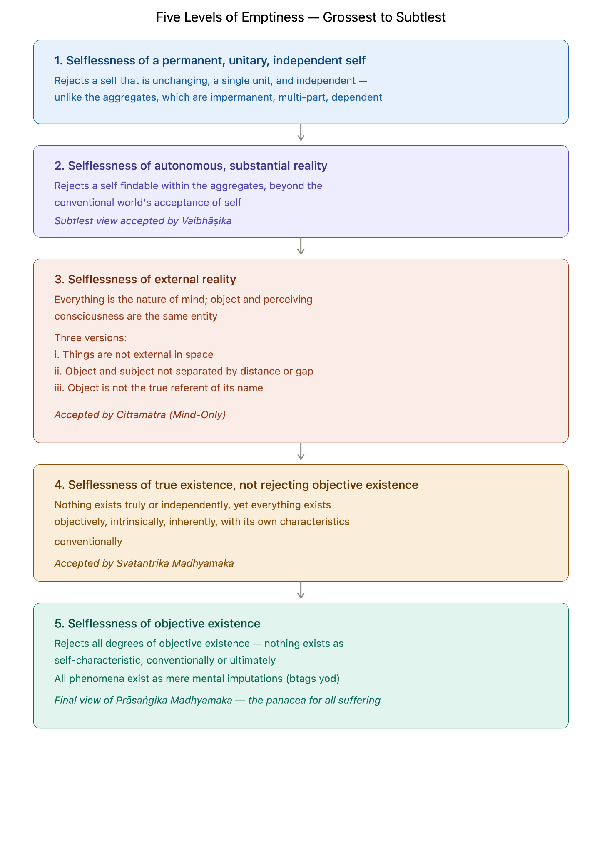
Five Levels of Emptiness (or five levels of selflessness)
Based on the sources, the five levels of Emptiness (or five levels of selflessness) represent a progressive framework of understanding reality from grosser to subtler levels.
1. Selflessness of Permanent, Unitary, and Independent Self
- Ātman: Two Meanings in Two Contexts.
The term ātman can carry two different meanings, depending on context.
First, ātman as the self, or person, that exists — such a self is not rejected, for the Buddha himself said, “You are the master of yourself.”
Second, when philosophers attempt to explain the nature of this self, they describe it as permanent, unitary, and independent. Such a self, or ātman, is rejected in Buddhism — because the self is accepted to be empty of permanent, unitary, and independent existence. - Definition: This level negates a “grossly solidified version, objectified version of the self”.
- Exact words: It rejects a self conceived as permanent (not changing), unitary (a single unit without parts), and independent (not depending on anything else).
- Contrast: This view is in “stark contrast with the aggregates” (body and mind), which are “impermanent,” have “multiple parts,” and are “dependent”.
2. Selflessness of Autonomous, Substantial Reality
- Tibetan: rang kya thupay zay yoe kyi dhagmay.
- Also known as: “Selflessness of the self-sufficient, substantial self”.
- Explanation: A Phenomena Being Empty of Autonomous, Substantial Reality
A phenomenon that a mind identifies through identifying something else — this is what it means for it to lack autonomous, substantial reality.
In other words, we identify the self by identifying something else that is not the self — such as the aggregates. Therefore, the self is Empty of Autonomous, Substantial Reality. The “self” that is thought to be findable by going into the aggregates, searching for something beyond what the conventional world already accepts as the self, is posited to be the autonomous, real self. - Application to Phenomena: Regarding a flower, lower schools say it is empty of “being the possession of the person which is conceived as autonomous substantially real”.
- Tenet Context: This is the “subtlest version of Emptiness” for schools like the Vaibhashika and Sautrantika.
3. Selflessness of External Reality
- Tenet Context: This is the primary philosophy of the Chittamatra (Mind-Only) school.
- Definition: It asserts that everything is the “nature of the mind,” meaning “things are the same entity as the direct perception which perceives them”.
- Three Versions of this Level:
- Emptiness of external reality: Things are “not external in space”.
- Emptiness of substantial duality of the object and subject: This negates seeing the object and subject as “separated by distance” or “separated by gap”.
- Emptiness of the objects being the true referent of the label: This means the object (like a flower) is not the “true referent” of the name given to it by convention.
4. Selflessness of True Existence while not Rejecting Objective Existence
- Tenet Context: This level is accepted by the Svatantrika Madhyamika school.
- Exact words: It propounds that nothing exists truly or independently, yet “everything exists objectively, intrinsically, and inherently“.
- Explanation: It identifies the object of negation as “an existence through its own objective mode of being and not posited in dependence on the object’s appearance to the mind”.
- Distinction: They assert that while things lack “true existence,” they still exist with their “own characteristics” conventionally.
5. Selflessness of Objective Existence
- Tenet Context: This is the final, subtlest view accepted by the Prasangika Madhyamika school.
- Synonyms: It is also referred to as the Emptiness of intrinsic, inherent, ultimate, or independent existence.
- Exact words: It rejects all degrees of objective existence, asserting that “nothing exists objectively, nothing exists as self-characteristic whether conventionally or ultimately”.
- Logic: It establishes that “100% from the object nothing really exists” and that all phenomena exist as “mere mental imputations” (btags yod) or “merely subjective”.
- The Goal: Realising this subtlest level is described as the “only panacea to heal the pains” of all sentient beings.
Continue exploring
The same ground, in other forms
Related by topic rather than by format — which is how a transcript, a diagram and a guided meditation on emptiness find each other.
Emptiness vs. Nihilism
A short teaching by Ven. Geshe Dorji Damdul.
Emptiness in 11 Minutes
A short teaching by Ven. Geshe Dorji Damdul.
The Wonder of Emptiness
A short teaching by Ven. Geshe Dorji Damdul.
Chittamatra and Quantum Physics
A short teaching by Ven. Geshe Dorji Damdul.