Dharma in Brief
Ultimate Analysis of the Flower: the Mental Electron Microscope
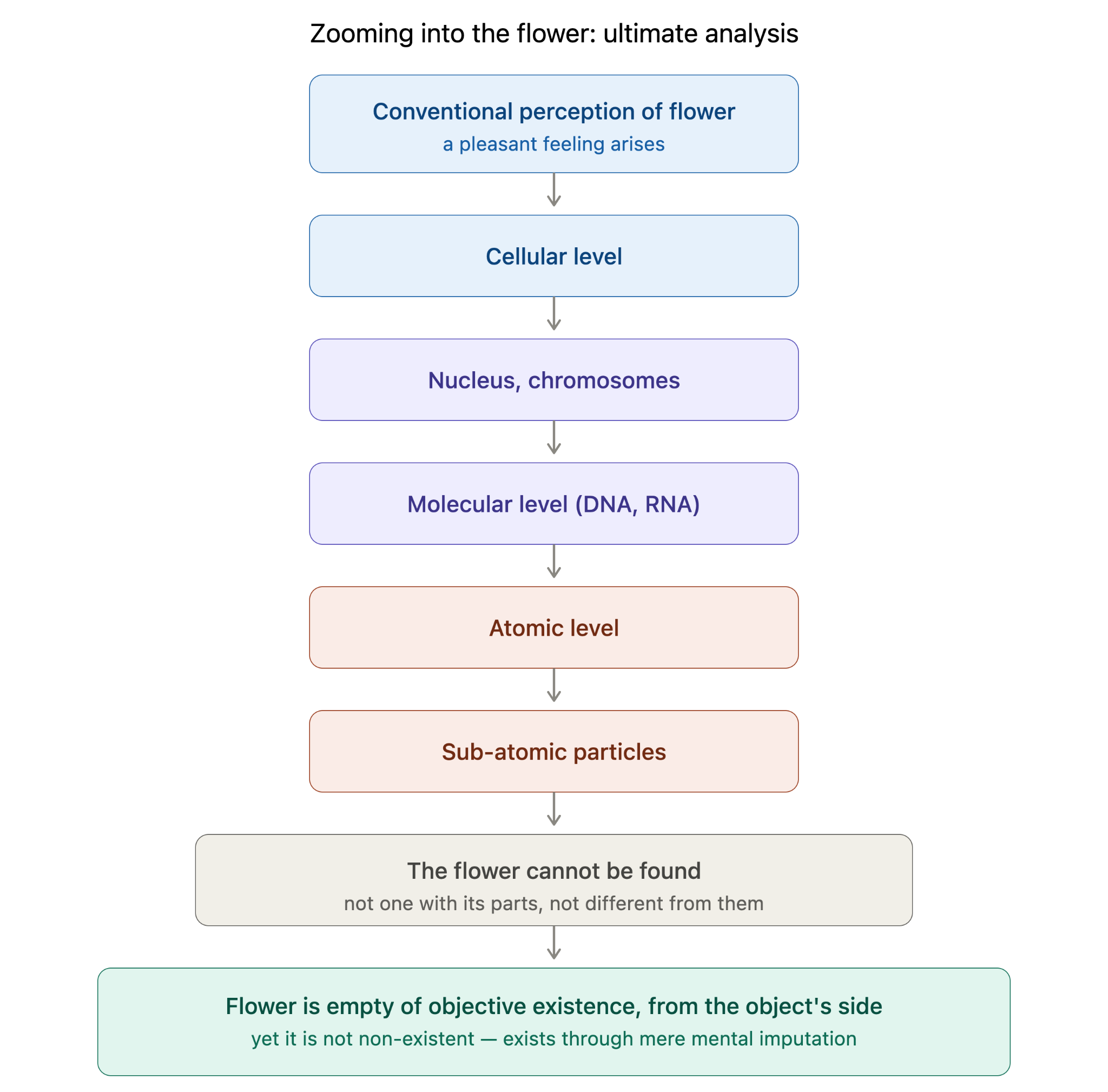
In the process of ultimate analysis (don dam dpyod byed kyi tshad ma), the practitioner employs a mental “electron microscope” to investigate whether a flower exists from its own side (rang ngos nas), or whether it is merely a mental construct. This “zooming in” process moves through several specific anatomical and sub-atomic layers:
1. The Starting Point: Conventional Perception
The investigation begins with the flower as it appears to conventional analysis (tha snyad dpyod byed kyi tshad ma) — an analysis from a distance that does not probe the object’s mode of subsistence. To the naked eye, the flower appears as a solid, “objectively real,” and attractive entity.
2. The Mental Dissection (The “Zooming In”)
As the practitioner fine-tunes their mental perception, they move from the gross appearance to increasingly subtle levels of constituent parts:
Surface and texture: Initially, one sees the smooth complexion of the petals, but under closer inspection, this becomes “hairy,” or appears like “cracked mud” — representing the partitions of cell membranes.
Cellular level: The analysis moves to the level of cells, identifying the cell membrane, cytoplasm, and nucleus.
Nuclear components: Within the nucleus, one observes chromosomes, described as “repulsive to look at, like the snake — brownish snake’s stripes.”
Molecular level: The chromosomes are further broken down into DNA and RNA molecules.
Atomic level: The molecules are dissected into atoms (rdul phra mo).
Sub-atomic level: The atoms are broken down into electrons, protons, and neutrons.
Elementary particles: The analysis can even extend to quarks.
3. The Result of the Analysis: Non-Findability
At each level, the practitioner asks the critical question: “Which of these is the flower?” This search yields the following conclusions:
The object disappears: “The moment you go too close to this object, then the flower disappears.”
None of the parts are the whole: At the atomic level, none of the atoms is the flower. The flower is “not one with its parts, nor is it different from its parts.”
Failure to withstand analysis: Because the flower cannot be found under this scrutiny, it is said that the flower “cannot withstand” (bzod pa) ultimate analysis.
4. Final Philosophical Implications
Discovery of Emptiness: What the mind finds in place of the disappeared flower is its emptiness (stong pa nyid) — specifically, the absence of objective existence.
Subjective imputation: The flower “nobody created — it is my mind which created this flower,” through the power of mental imputation (btags yod), or conceptualization (rtog pa).
The “Powers of Ten” analogy: The recommendation is repeatedly made to watch the NASA Powers of Ten clip as a visual aid, to understand how zooming into a leaf reveals a pool of atoms in which the “leaf-ness” is no longer findable. Recommended to watch “Power of 10” created by NASA.YoutTube Link: https://youtu.be/_CWb1NiLpPA
Continue exploring
The same ground, in other forms
Related by topic rather than by format — which is how a transcript, a diagram and a guided meditation on emptiness find each other.
Emptiness vs. Nihilism
A short teaching by Ven. Geshe Dorji Damdul.
Emptiness in 11 Minutes
A short teaching by Ven. Geshe Dorji Damdul.
The Wonder of Emptiness
A short teaching by Ven. Geshe Dorji Damdul.
Chittamatra and Quantum Physics
A short teaching by Ven. Geshe Dorji Damdul.