Dharma in Brief
Emptiness, Dependent Origination and the Middle Way
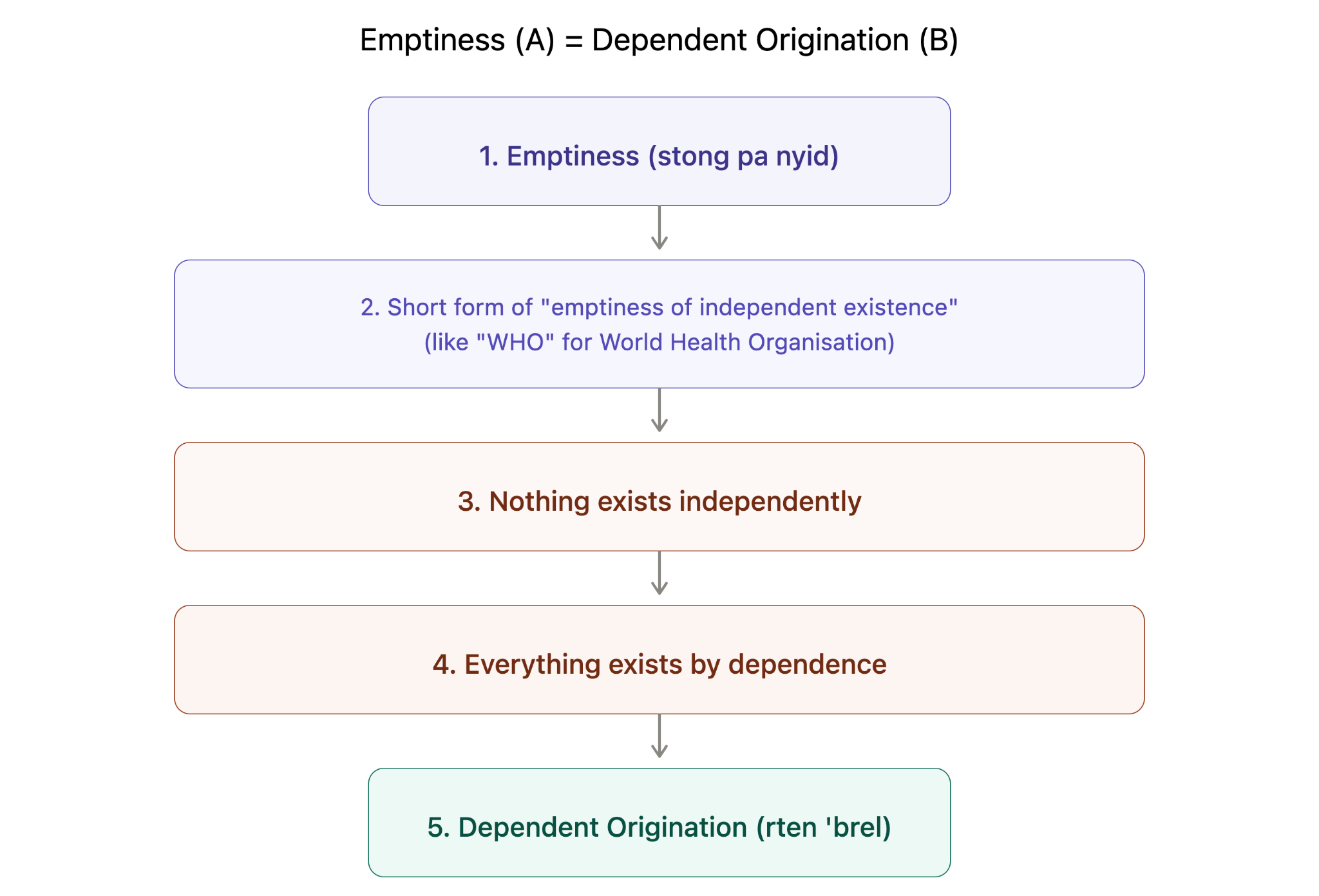
To understand how Emptiness (stong pa nyid) equals Dependent Origination (rten ‘brel), the sources provide the following five points of logical deduction:
Emptiness (stong pa nyid)
Short-form terminology: Emptiness is not nothingness — it is the short form of “Emptiness of independent existence.” This is comparable to using the acronym “WHO” as shorthand for the “World Health Organisation.”
Lack of independent existence: Emptiness of independent existence means “nothing exists independently.”
Existence by dependence: Nothing existing independently means “everything exists by dependence,” or is “dependently existent.”
Dependent Origination (rten ‘brel): Everything existing dependently means “everything is dependently originated.”
How Does Dependent Origination Equal the Middle Way?
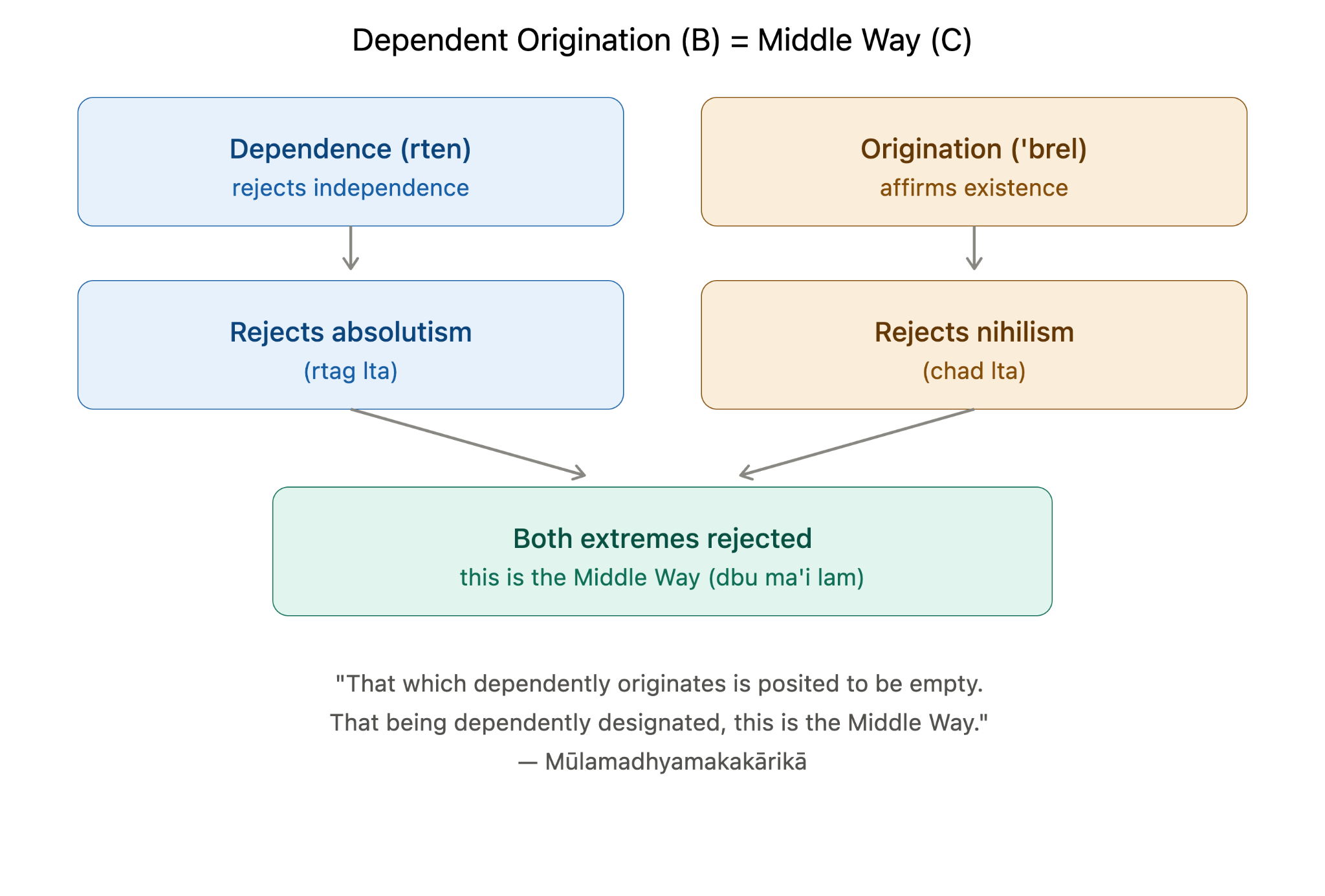
To understand how Dependent Origination (rten ‘brel) equals the Middle Way (dbu ma’i lam), the term itself contains a logic that simultaneously rejects the two extremes of existence. The logical steps are as follows:
Dependence (rten) rejects independence: “When you say dependent, it rejects independence.”
Independence equals absolutism: “Independence and absolutism (rtag lta) — these two mean the same.” Therefore, the “dependence” side of the term rejects the extreme of absolutism.
Origination (‘brel) affirms existence: “When we say origination, it means something comes into origination, something comes into existence.”
Origination rejects nihilism: This side of the term rejects “non-existence,” or “nihilism (chad lta),” because it establishes that things do indeed arise.
Rejection of both extremes is the Middle Way: “Bringing the two together, dependent and origination together reject the two extremes. Rejecting the two extremes is following the Middle Way.”
This logic is fundamentally grounded in the famous stanza from Ārya Nāgārjuna’s Mūlamadhyamakakārikā (Fundamental Wisdom of the Middle Way):
“That which dependently originates Is posited to be empty (of independent existence). That being dependently designated, This is the Middle Way.”
The Salistambha Sūtra and Its Teaching on Dependent Arising
Furthermore, the Bhagavān, the Lord of Dharma, the Omniscient One, said in the Rice Seedling Sutra: ‘Bhikṣus, whoever sees dependent arising sees the Dharma. Whoever sees the Dharma sees the Buddha.’
The famous statement, “Bhikṣus (dge slong), whoever sees dependent arising (rten ‘brel) sees the Dharma (chos). Whoever sees the Dharma sees the Buddha (sangs rgyas),” originates from the Śālistamba Sūtra (Rice Seedling Sūtra; sā lu ljang pa’i mdo), where it is presented as a profound teaching on the nature of reality.
In Buddhist philosophy, particularly within the Nālandā tradition, this is explained through several interconnected layers:
To “see” dependent arising does not merely mean observing the gross physical process of a seed becoming a sprout. It means understanding that phenomena arise based on conditions, and therefore lack intrinsic existence (rang bzhin gyis grub pa).
The phrase “dependent arising” means: because this exists, that exists; because this is produced, that is produced.
Ultimately, this establishes a set of equations: Emptiness = Dependent Origination (A = B), and Dependent Origination = Middle Way (B = C) — leading to the final deduction that Emptiness = Middle Way (A = C).
This reasoning is hailed as the “king of reasoning,” because it allows the functionality and emptiness of a phenomenon to be seen as harmonious and interwoven, rather than contradictory.
His Holiness the Dalai Lama, therefore, summarised these Three Levels of Dependent Origination, drawing on his lifelong practice, study, and teaching.
Continue exploring
The same ground, in other forms
Related by topic rather than by format — which is how a transcript, a diagram and a guided meditation on emptiness find each other.
Emptiness vs. Nihilism
A short teaching by Ven. Geshe Dorji Damdul.
Emptiness in 11 Minutes
A short teaching by Ven. Geshe Dorji Damdul.
The Wonder of Emptiness
A short teaching by Ven. Geshe Dorji Damdul.
Chittamatra and Quantum Physics
A short teaching by Ven. Geshe Dorji Damdul.