Dharma in Brief
What is Emptiness? Passing Through Two Gates
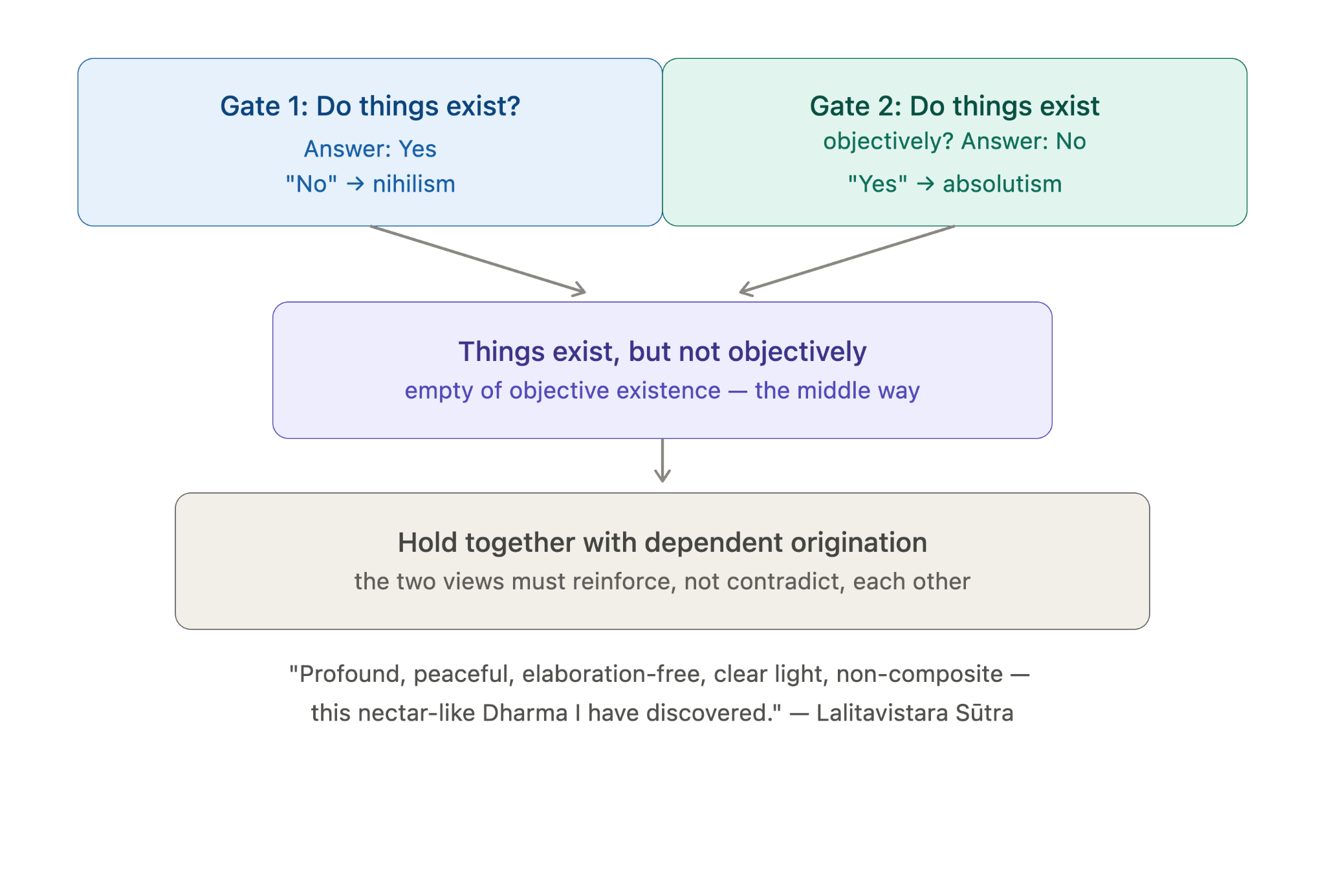
To understand this topic, one needs to pass through two gates. You ask yourself two questions:
Do things exist? The answer should be “Yes.” If you say “No,” you fall to one extreme — nihilism. This is not emptiness.
Do things exist objectively? The answer should be “No.” If you say “Yes,” you fall to the other extreme — absolutism. This is also not emptiness.
Only when you can pass through both gates successfully can you draw closer to understanding emptiness. Now, combine the two gates — what do you understand? Things exist, but they do not exist objectively. They are empty of objective existence.
To avoid sliding into these extremes — especially the extreme of nihilism, which may lead one into much negative karma by denigrating the functionality of things — one should always hold the understanding of emptiness alongside dependent origination. Understanding them together ensures that one does not fall into either extreme. When your understanding of emptiness and of dependent origination do not contradict each other, but instead reinforce and complement one another, you are moving in the right direction toward understanding emptiness.
These are very profound realities, requiring great care in how they are approached. It is for this reason that the Buddha remained silent for forty-nine days and did not teach after attaining enlightenment. It was only at the request of Indra, Brahmā, and the celestial beings — who entreated him to turn the Wheel of Dharma — that the Buddha began to teach.
The Buddha said in the Lalitavistara Sūtra:
“Profound, peaceful, elaboration-free, clear light, and non-composite; Such is the nectar-like Dharma I have discovered. Finding no one to fathom this teaching, In silence I will retire into the woods.”
What Is Emptiness?
Make sure to know the following three statements and how they are true.
Emptiness = A
Dependent Origination = B
Middle Way = C
Emptiness equals Dependent Origination (A = B)
Dependent Origination equals Middle Way (B = C)
Emptiness equals Middle Way (A = C)
Continue exploring
The same ground, in other forms
Related by topic rather than by format — which is how a transcript, a diagram and a guided meditation on emptiness find each other.
Emptiness vs. Nihilism
A short teaching by Ven. Geshe Dorji Damdul.
Emptiness in 11 Minutes
A short teaching by Ven. Geshe Dorji Damdul.
The Wonder of Emptiness
A short teaching by Ven. Geshe Dorji Damdul.
Chittamatra and Quantum Physics
A short teaching by Ven. Geshe Dorji Damdul.