Dharma Transcripts
Wisdom of Emptiness Retreat — Day 8: 18 August 2026
Session One — Day Eight Meditation Session
17 August 2026 05:45 AM – 08:00 AM
Deer Park Institute, Bir
Prayers and Practice
Generating the Mind of Consummate Yoga
Session Two — Day Eight
17 August 2026 09:00 AM – 10:30 AM
Deer Park Institute, Bir
Readings and Reflection on “In Praise of Dependent Origination”.
The night-lily grove of Nāgārjuna’s treatises—
Nāgārjuna, whom You prophesied
Would unravel Your unexcelled vehicle as it is,
Shunning extremes of existence and non-existence.Night-lily grove of Nāgārjuna’s treatises: Mulamadhyamakakarika
Unexcelled vehicle – Mahayana VehicleIlluminated by the garland of white lights
Of Chandra’s well-uttered insights—
Chandra, whose stainless wisdom orb is full,
Who glides freely across scriptures’ space,garland of white lights of Chandra’s well-uttered insights – Madhyamakavatara
Who dispels the darkness of extremist hearts
And outshines the constellations of false speakers—
When, through my teacher’s kindness, I saw this,
My mind found rest at last.
Teachings on the The Fundamental Wisdom of the Middle Way, Chapter 18: Examination of Self and Phenomena (Page 146, Blaze)
- If the self were the aggregates,
It would have arising and ceasing as its properties.
If it were different from the aggregates,
It would not have the characteristics of the aggregates.
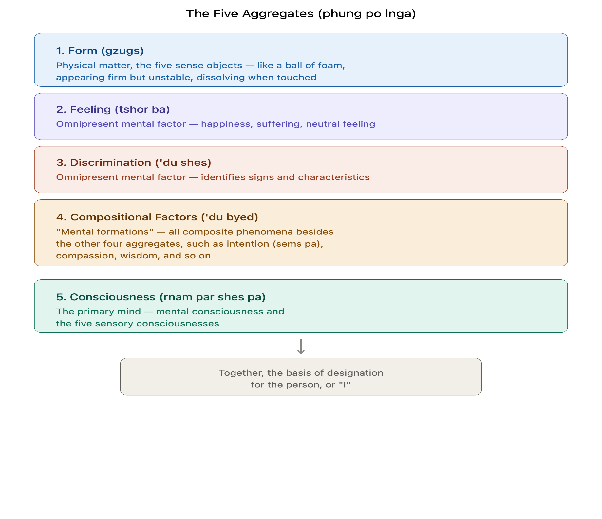
The five aggregates (Tibetan: phung po lnga) are the basis of designation for the person, or “I.” They are:
- Aggregate of Form (gzugs kyi phung po): This includes physical matter and the five sense objects — forms, sounds, and so on. It is described as being like a ball of foam — appearing firm, but becoming unstable and disappearing when touched.
- Aggregate of Feeling (tshor ba’i phung po): One of the five omnipresent mental factors (kun ‘gro lnga) that accompanies any mind. It involves the experience of happiness, suffering, and neutral feeling.
- Aggregate of Discrimination (‘du shes kyi phung po): Also categorized as an omnipresent mental factor, it is the mental function that identifies signs and characteristics.
- Aggregate of Compositional Factors (‘du byed kyi phung po): Sometimes translated as “mental formations,” this category includes all composite phennomena except for the other four aggregates, such as mental factor of intention (sems pa), compassion, wisdom, etc.
- Aggregate of Consciousness (rnam par shes pa’i phung po): This refers to the primary mind — specifically, the mental consciousness (yid kyi rnam par shes pa) and the five sensory consciousnesses.
The 51 Mental Factors (sems byung): Six Primary Categories
1. Five Omnipresent Mental Factors (kun ‘gro lnga)
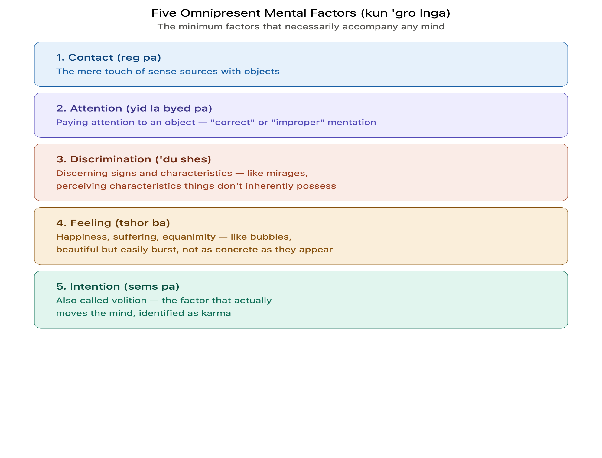
These are defined as the minimum factors that necessarily accompany any mind:
- Contact (reg pa): The mere touch of sense sources with objects.
- Attention (yid la byed pa): Also translated as “correct mentation,” or “improper mental attention” when distorted. It involves paying attention to an object.
- Discrimination (‘du shes): The function of discerning, or identifying, signs and characteristics. It is described as being like mirages, because it perceives things as having characteristics they do not inherently possess.
- Feeling (tshor ba): The experience of happiness, suffering, and equanimity — likened to bubbles: beautiful, but easily burst, and not as concrete as they appear.
- Intention (sems pa): Also known as volition. This is the factor that actually moves the mind, and is identified as karma.
Meditation on the Emptiness of the Person
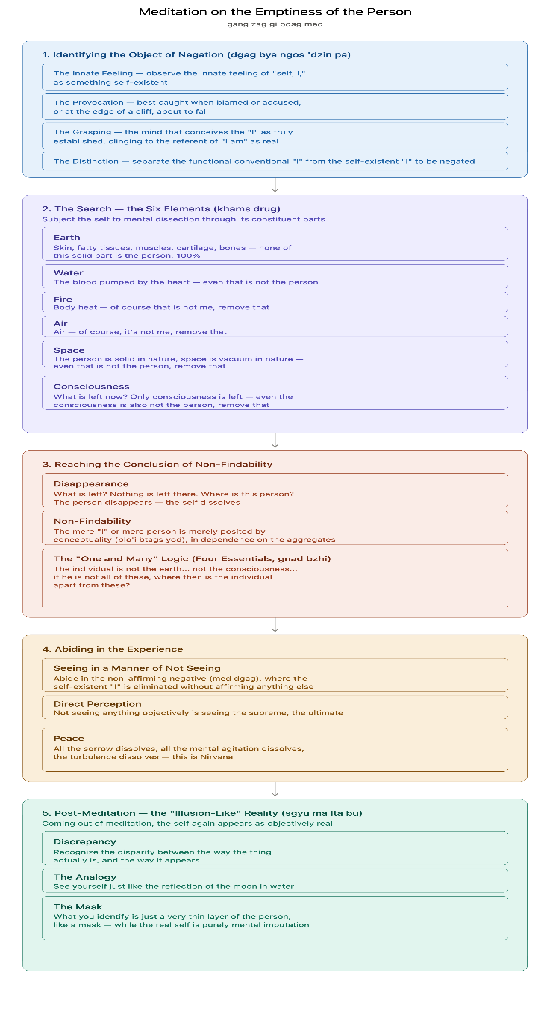
The method to meditate on the Emptiness of the Person (gang zag gi bdag med) involves a systematic analytical process aimed at identifying the “self” and then searching for it using ultimate analysis (don dam dpyod byed kyi tshad ma).
1. Identifying the Object of Negation (dgag bya ngos ‘dzin pa)
Before searching, you must catch the “vibrant” sense of a solidified self:
- The Innate Feeling: Observe the “innate feeling self, I, as something… self-existent”.
- The Provocation: It is best caught when “somebody blames or makes an allegation” or when “we are at the edge of a cliff and about to fall down”.
- The Grasping: Identify the mind that “conceives the I to be truly established” and “manifestly clings to the referent of the thought ‘I am’ as real”.
- The Distinction: You must separate the “conventional I which is functional” from the “self-existent I” that is to be negated.
2. The Search: The “Six Elements” Analysis (khams drug)
Subject the self to mental dissection by searching through its constituent parts:
- Element of Earth: “Going closer to the object first we see the very thin layer of the skin. This is not the person. Beyond that is the fatty tissues, beyond that muscles, cartilages, the bones… None of these solid part is the person, 100%”.
- Element of Water: Remove the “blood which is pumped in out by heart to different parts of the body. Even that is also not the person”.
- Element of Fire: “Body heat, of course that is not me, remove that”.
- Element of Air: “Air, of course, it’s not me… remove that”.
- Element of Space: “The person is solid in nature, the space is as vacuum in nature. Even that is not the person, remove that”.
- Element of Consciousness: “What is left now? Only the consciousness is left… even the consciousness is also not the person, remove that”.
3. Reaching the Conclusion of Non-Findability
Through this dissection, the practitioner reaches the logical “dead end”:
- Disappearance: “What is left? Nothing is left there. Where is this person? The person disappears… the self dissolves, it disappears”.
- Non-Findability: Realize that the “mere I or mere person… is merely posited by conceptuality (blo’i btags yod) in dependence upon the aggregates”.
- The “One and Many” Logic: Apply the Four Essentials (gnad bzhi) to conclude: “The individual is not the earth… not the consciousness… if he is not all these, where then is the individual apart from these?”.
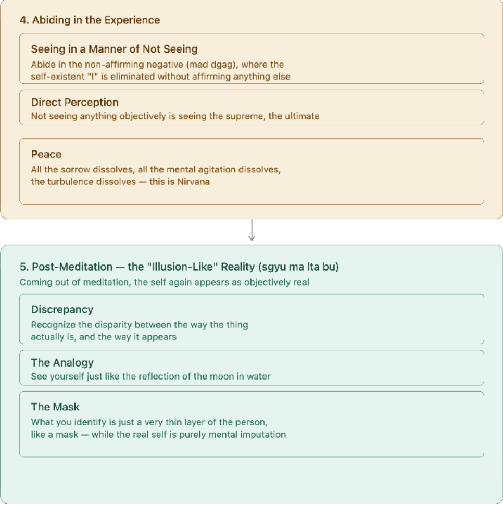
4. Abiding in the Experience
- Seeing in a Manner of Not Seeing: Abide in the “non-affirming negative” (med dgag) where the “self-existent I” is eliminated without affirming anything else in its place.
- Direct Perception: “Not seeing anything [objectively] is seeing the supreme, seeing the ultimate”.
- Peace: In this state, “all the sorrow dissolves, all the agitation, mental agitation dissolves. The turbulence dissolves… this is Nirvana”.
5. Post-Meditation: The “Illusion-Like” Reality (sgyu ma lta bu)
When you “come out of the meditation,” the self will again appear as objectively real:
- Discrepancy: Recognize the “disparity between the way the thing actually is and the way it appears”.
- The Analogy: See yourself “just like the reflection of moon in water”.
- The Mask: Understand that what you identify is “just a very thin layer of the person… like a mask,” while the real self is “purely mental imputation”.
Ven Geshe la will teach “TheTwelve Links of Dependent Origination” – Kind Reminder.
Completed the explanation of Chapter 18.
Session Three — Day Eight
17 August 2026 11:30 AM – 12:30 PM
Deer Park Institute, Bir
Teachings on The Fundamental Wisdom of the Middle Way, Chapter 26: Examination of the Twelve Links of Saṃsāric Existence
Verse 1
The obscuring Ignorance propels (one) into (saṃsāric) birth.
The three Compositional Factors
Enhance the formation (of births).
These actions impel (one) into the state of migrators.
The Three Compositional Factors
Non-virtuous Karma (Black Part)
- Non-meritorious Karma — results in taking birth in the three lower realms of the desire realm.
Virtuous Karma (White Part) 2. Meritorious Karma — results in taking birth in the three higher realms of the desire realm (these karmas, though virtuous, can waver). 3. Unwavering Karma — results in taking birth in the form and formless realms (these karmas are virtuous and do not waver).
Verse 2
Having composition as its condition,
Consciousness enters transmigration.
Once consciousness has entered transmigration,
Name and form come into being.
Composition — karma, because it decides the composition of the next birth: what the birth is going to be like.
Verse 3
Once name-and-form come to be,
The six Sense Sources come into being.
Depending on the six sense sources,
Contact, unwaveringly, comes into being.
Verse 4
Arising is only dependent
Upon eye, form and attention.
Thus, depending on name and form
Consciousness is produced.
Verse 5
That which is assembled from the three—
Eye, form and consciousness—
Is contact,
From contact arises Feeling.
Verse 6
Conditioned by feeling, arises Craving,
Craving arises because of feeling.
When it arises, there is Grasping
Which comprises the four.
Four Types of Grasping
- Grasping of Desire — attachment to the objects of the desire realm as real.
- Grasping at the Claim of the Self — attachment to the form and formless realms.
- Grasping of the View — attachment to wrong views.
- Grasping of the Supremacy of Morality and Conduct — grasping to the supremacy of some morality and conduct, such as believing that animal sacrifice will lead to happiness or success.
Verse 7
When there is grasping,
The Existence of the one who craves comes into being.
If there is no grasping,
Then being freed, one would not take (saṃsāric) Birth.
Verse 8
This birth is comprised of five aggregates.
From existence arises birth,
Then Ageing and Death and misery,
Moaning and suffering.
Five aggregates — Form comes from this life’s parents; all the other four aggregates come from past lives.
Verse 9
Grief and confusion.
All these arise entirely because of birth.
In this way, this very mass of suffering
Comes into being.
Birth
— voluntary birth.
Verse 10
The root of cyclic existence is compositional (factors). Compositional (factors) — karma. The germinated version of karma is number 10 — Becoming. Number 10 is the cause of birth. Verse 11 With the cessation of ignorance, Insight and meditation — Cultivate wisdom endowed with two qualities: Verse 12 Through the cessation of these, Finally, this Insight and Meditation should be with respect to Emptiness. The session ended with questions and answers. Be kind to yourself — be happy. Be wisely kind to yourself — be wise by resorting to the actual causes of happiness: what can actually make you happy. This is the virtue of renunciation or the virtue of refraining from negativities. At the outset of the path, a wise practitioner must take the initial step to guard their physical, verbal, and mental actions and eradicate non-meritorious deeds. Specifically, this means refraining from the ten non-virtuous actions (mi dge ba bcu): By avoiding these ten non-virtues, a practitioner safeguards themselves from falling into the “great abyss” of bad rebirths and ensures a favorable birth (mngon mtho) in the human or celestial realms, where they will have the conductive circumstances to continue studying and practicing the Dharma
Therefore, the wise do not engage in compositional (factors).
Thus, the unwise are the agents.
The wise see reality.
Compositional (factors) will not arise.
The cessation of ignorance occurs through
Insight and meditation.
Those will not be manifest.
The entire mass of suffering
Indeed, thereby, completely ceases.
Take-Away from This Retreat
Wisely, meaning:
Part 1: “Do not commit any non-virtuous actions”
1. The Meaning
Continue exploring
The same ground, in other forms
Related by topic rather than by format — which is how a transcript, a diagram and a guided meditation on emptiness find each other.
Emptiness vs. Nihilism
A short teaching by Ven. Geshe Dorji Damdul.
Emptiness in 11 Minutes
A short teaching by Ven. Geshe Dorji Damdul.
The Wonder of Emptiness
A short teaching by Ven. Geshe Dorji Damdul.
Chittamatra and Quantum Physics
A short teaching by Ven. Geshe Dorji Damdul.