Dharma Transcripts
Wisdom of Emptiness Retreat — Day 6: 16 August 2026
Session One — Day Six Meditation Session
16 August 2026 05:45 AM – 08:00 AM
Deer Park Institute, Bir
Prayers and Practice
Generating the Mind of Consummate Yoga
Session Two — Day Six
16 August 2026 09:00 AM – 10:30 AM
Deer Park Institute, Bir
The Set of Five Pairs
- Subjective × Objective
- Conventional × Ultimate
- Dependent × Independent
- Deceptive × True Existence
- Relative Existence × Absolute Existence
“Convention” carries the sense of mind. Some people’s minds decide, or see, things in a certain way — and mind is the subject. Therefore, “convention” and “subjective” are synonyms.
Reflection on Some Examples
- Dream — subjective.
- Mirage — subjective.
- Rainbow — some say subjective, some say objective.
Discussion and food for thought: If you are with a small child and they ask you to take them to the rainbow, you will not do so — because there is nothing there from the side of the object, the rainbow. So the small child thinks that the rainbow exists objectively, while the elders say that the rainbow exists subjectively.
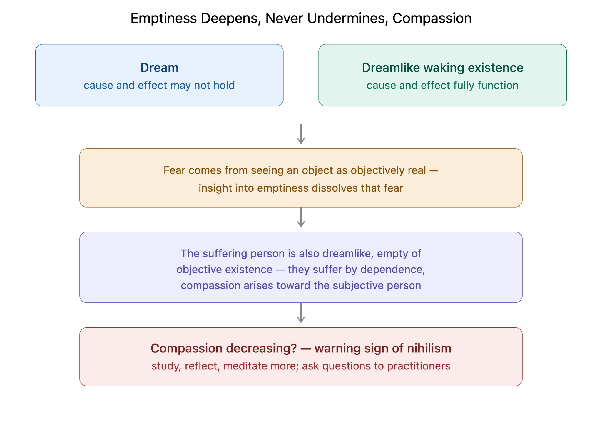
With the understanding, or wisdom, of emptiness, compassion should never be undermined. How is this so?
There is a crucial difference between a dream and something dreamlike. Within an actual dream, cause and effect may not function reliably. But within this dreamlike waking existence, cause and effect continue to operate with full efficacy. Nothing about seeing things as dreamlike suspends the laws of karma or consequence.
The fear we experience is never truly caused by the object itself — it is caused by our recognition of that object as objectively, independently real. The moment insight into emptiness dawns, this fear dissolves.
But here is the crucial point: you also come to recognize that the suffering person before you is likewise empty of objective existence — dreamlike, dependently originated. And yet, you see that they suffer by dependence, within this web of cause and effect. And so compassion arises toward this subjectively suffering person.
If, then, your insight into the wisdom of emptiness ever seems to undermine your compassion — if you notice yourself caring less, rather than more — this is a warning sign. It is an indication that you may be sliding toward the extreme of nihilism. If this happens, continue to study, reflect, and meditate more deeply. And do not hesitate to ask questions of those who are further along in this study and practice.
Emptiness and compassion are never in tension. When rightly understood, they deepen one another — the less objective we see the world to be, the more tender our response to its suffering becomes.
How to Find Out Whether Things Exist Objectively or Ultimately
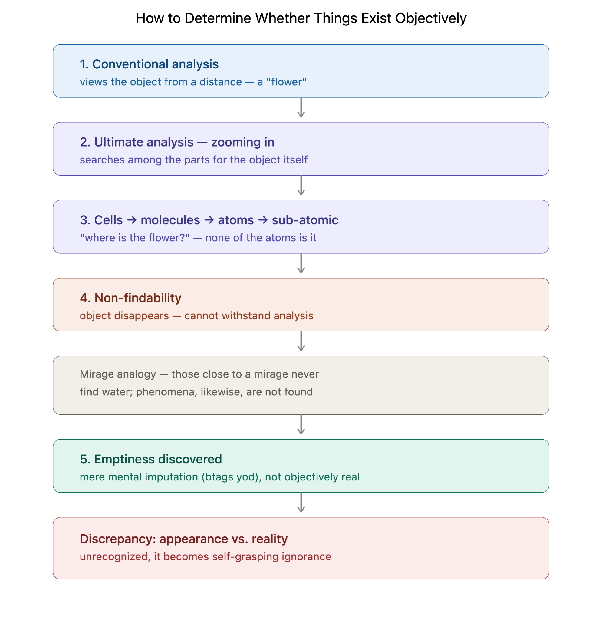
One should subject the object to ultimate analysis — meaning, moving in toward the object itself. If the object disappears under this scrutiny, it does not exist objectively; it is empty of objective reality.
Consider the mirage analogy. Ārya Nāgārjuna said in the Precious Garland (Ratnāvalī):
“If the mirage were water, why do those close to the mirage not see the water?”
In the same way, when you draw closer to any phenomenon and analyze it through ultimate analysis, it cannot be found. This is precisely what it means for something to be empty of objective existence.
To determine if phenomena exist objectively (rang ngos nas grub pa) or ultimately (don dam par), they must be subjected to ultimate analysis (don dam dpyod byed kyi tshad ma).
1. The Investigative Process
The investigation requires “employing the reasons to see whether the object actually exists from the object side or not”. This involves “zooming in” or “going closer towards the object” to probe its final mode of subsistence (sdod lugs).
- Conventional Analysis (tha snyad dpyod byed kyi tshad ma): This “looks at it from a distance” and perceives the object as it appear to the world, such as seeing a “flower”.
- Ultimate Analysis: This “crosses the border of the conventionality” by searching for the specific referent of a label among its parts.
2. The Mental Dissection (“Zooming In”)
The practitioner mentally divides the object into its constituents to find where the “real” entity resides:
- “You mentally go into the constituents… You look into the constituents, the parts, and ask, ‘Where is the flower?'”.
- The analysis moves from the gross appearance to “cells,” then “DNA molecules,” then “atoms” (rdul phra mo), and finally “subatomic particles”.
- At this level, “none of the atoms is the flower”.
3. The Result: Non-Findability and Disappearance
The hallmark of an object that lacks objective reality is its failure to “withstand” scrutiny:
- Disappearance: “The moment you go into the ultimate analysis… the object disappears”.
- Withstanding Analysis: “If the flower does exist objectively, ultimate analysis should be able to find the flower. If it finds it, the object withstands the ultimate analysis”.
- Failure to Withstand: Because the object is not findable under inspection, it is said that it “cannot withstand the ultimate analysis”.
4. The Mirage Analogy (smig rgyu)
As cited in the sources, Arya Nagarjuna (’phags pa klu sgrub) uses this logic in the Precious Garland (ratnāvalī):
- “If the mirage were to be water, why not those close by the mirage see water?”.
- The Application: “Likewise, if this person would exist objectively why not I see this person as I go closer to this object”.
- The Conclusion: Just as the water in a mirage is “purely the appearance to your mind” and “not at all truly there,” all phenomena are found to be empty of intrinsic existence (rang bzhin gyis grub pa) when analysed.
5. Final Realisation
What is found by the ultimate analysis is not the object itself, but its Emptiness (stong pa nyid):
- “Not seeing anything [objectively] is seeing the reality”.
- “What you find is the emptiness of this flower. That the flower disappears”.
- The sources conclude that things exist only as “mere mental imputations” (btags yod) or “merely conventional” truths that “appear as real” to an ignorant mind but are “empty from the object side”.
Through this process, one discovers the discrepancy between appearance and reality. The Buddha said that there is a discrepancy between the appearance and the reality of phenomena. Not being able to see this discrepancy, one grasps at the objective, or true, existence of things – and this is self-grasping ignorance.
Session Three — Day Six
16 August 2026 11:30 AM – 12:30 PM
Deer Park Institute, Bir
Topics Covered:
The Mount Kailash analogy is used in the sources to illustrate the distinction between how reality appears to an ordinary mind and how it is perceived by a realised mind, directly linking these perspectives to the states of Samsara (‘khor ba) and Nirvana (mya ngan las ‘das pa).
The Mount Kailash Analogy
The analogy involves two groups of people looking at Mount Kailash:
- Group A (Ordinary Beings): They put on a pair of “very dirty goggles” or glasses with “blue-tinted” lenses. When they look at the mountain, it appears “very dirty” or “blue”. They do not say, “I have a dirty appearance of Mount Kailash,” but rather assert as a fact: “Mount Kailash is dirty”. This “dirtiness” is purely a mental projection (blo’i btags yod) and does not exist from the side of the mountain.
- Group B (Arya Beings): They either have “very clean eyes” or remove the dirty goggles. When they look at the mountain, it is “very clean” and “pure”. They perceive the absence of dirtiness, which is the actual reality of the mountain that Group A was misperceiving.
The Two Perspectives (Analyses)
The sources use this analogy to define the two primary modes of investigation:
- Conventional Analysis (tha snyad dpyod byed kyi tshad ma): This is looking at the object “from a distance” without probing its final mode of existence. It validates conventional truth (kun rzob bden pa), such as seeing a “flower” or a “mountain”.
- Ultimate Analysis (don dam dpyod byed kyi tshad ma): This is “going closer towards the object” or using an “electron microscope” to see if the object exists objectively. Under this scrutiny, the projected object (the “dirty mountain” or the “solid flower”) disappears because it is found to be unfindable from its own side. What this mind finds is Emptiness (stong pa nyid)—the absence of objective existence.
Samsara and Nirvana
The analogy provides a profound definition for these two states:
Samsara (‘khor ba):
Definition: Samsara is described as being in a “dream” or a “sleep of ignorance” (ma rig pa’i gnyid), where one believes the projections of the mind are 100% real and objective.
- Mechanism: The moment you see something as objectively real (rang ngos nas grub pa), an “automatic pull and push” (attachment and aversion) happens, resulting in a “loss of freedom” (rang dbang med pa).
- Analogy Link: Samsara is synonymous with the perspective of Group A—living under the sway of “dirty goggles” (self-grasping ignorance), being affected by the projected “dirtiness” (afflictions), and having no freedom to see the mountain as it truly is.
Nirvana (mya ngan las ‘das pa):
Definition: Nirvana is “waking up” from the sleep of ignorance and discovering one’s “internal essence”. It is a state of “absolute peace” where the “turbulence of mind” is fully pacified.
- Mechanism: It is the cessation (‘gog pa) of the “involuntary pull and push” through the wisdom of Emptiness (stong pa nyid kyi shes rab).
- Analogy Link: Nirvana is the perspective of Group B—removing the “dirty goggles” to see the “undeceptive” reality. The sources state that “not seeing anything [objectively] is seeing the reality” of the mountain. In this context, Nirvana is defined as the “ultimate truth” (don dam bden pa) of the mind itself when it is freed from the “contamination of afflictions”.
I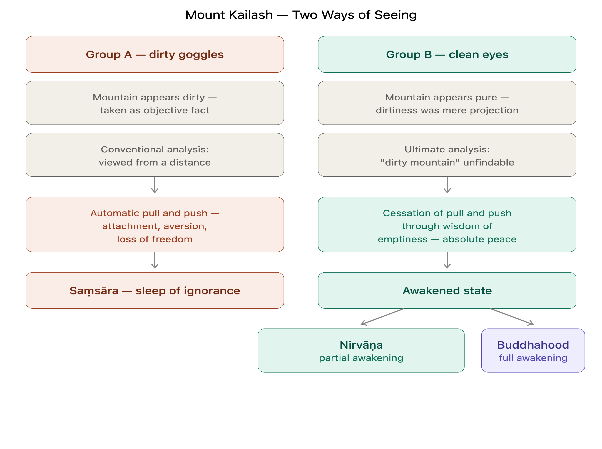
Ignorance vs. Wisdom
For wisdom to serve as the actual antidote to ignorance, it must stand in direct opposition to ignorance with respect to the very same object of apprehension.
- Ignorance sees things as objectively real.
- Wisdom sees things as not objectively real.
Reasoning of the Four Essentials to Establish Emptiness
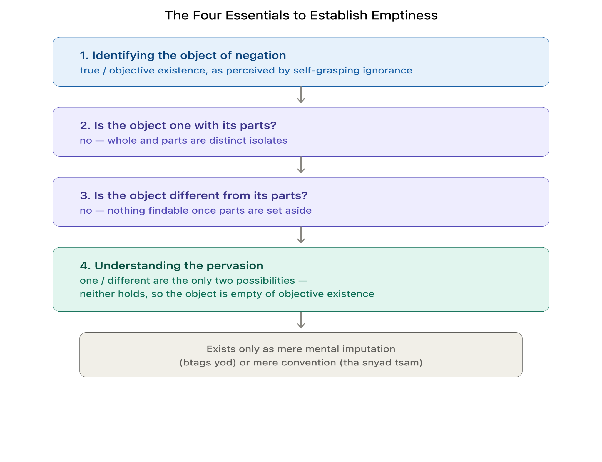
The Reasoning of the Four Essentials to Establish Emptiness (stong pa nyid sgrub byed kyi gnad bzhi) is a systematic analytical framework used to dismantle the belief in objective existence (rang ngos nas grub pa). These four essentials must be on a practitioner’s “fingertips” because they serve as the foundation for all rationalities used to establish emptiness.
1. The Essential of Identifying the Object of Negation (dgag bya ngos ‘dzin pa’i gnad)
The first and most important step is to clearly identify what is to be negated; without knowing the “measure” of the object of negation, one cannot realize its absence. The object of negation is true existence (bden grub), intrinsic existence (rang bzhin gyis grub pa), or objective existence (rang ngos nas grub pa). It is crucial to identify this not merely as a philosophical construct, but as it is perceived by the innate self-grasping ignorance (lhan skyes kyi bdag ‘dzin ma rig pa) that has operated in the mind since beginningless time. If the object of negation is not pinpointed accurately, any subsequent reasoning will fail to undermine the actual root of Samsara.
2. The Essential of Understanding the Pervasion (khyab pa’i gnad)
The final essential establishes the pervasion (khyab pa), confirming that these two possibilities—being one with or different from the parts—are exhaustive. It concludes that if a phenomenon exists objectively, it must be either intrinsically one with its parts or intrinsically different from them. Since the second and third essentials have already proven that the object is neither one with nor different from its parts, it follows that the object lacks objective existence and is therefore empty (stong pa).
3. The Essential of Understanding the Emptiness of the Object being One with its Parts (gcig bral gyi gnad)
This essential probes whether the object (such as the “I” or a flower) is intrinsically one with its constituents or parts. Through mental dissection, the practitioner searches among the parts—such as the five aggregates (phung po lnga) or the six elements (khams drug)—to see if any individual part or the collection of parts is the object itself. The conclusion reached is that the whole cannot be objectively identical to its parts, as they are distinct conceptual isolates (ldog pa) and have different functions.
4. The Essential of Understanding the Emptiness of the Object being Different from its Parts (du ma bral gyi gnad)
The third essential investigates whether the object is intrinsically different or separate from its parts. If the “I” or the flower existed as a separate, independent entity, it should remain findable even after all its parts are mentally removed. Under ultimate analysis, however, no such independent entity remains once the constituents (like the petals of a flower or the body and mind of a person) are set aside.
Mastering these four essentials allows a practitioner to transition from an intellectual understanding to a profound conviction that all phenomena exist only as mere mental imputations (btags yod) or mere conventions (tha snyad tsam).
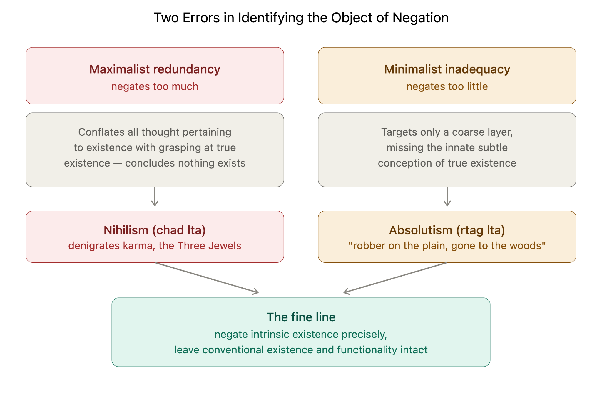
TWO POTENTIAL ERRORS IN IDENTIFYING THE OBJECT OF NEGATION.
The two primary errors or extremes to avoid when identifying the object of negation are maximalist redundancy and minimalist inadequacy. Finding the “very fine line” between these two is described as essential for reaching the realization of Emptiness (stong pa nyid).
Based on the sources, here are the exact descriptions of these two problems:
1. Maximalist Redundancy (Negating Too Much)
This error occurs when a practitioner fails to “demarcate what is to be negated” and ends up “negating everything”.
- The Error: People “conflate all forms of thought with grasping at true existence”. They erroneously conclude that because things lack intrinsic nature, they “simply do not exist at all”.
- The Consequence: This leads to the extreme of nihilism (chad lta), where one “denigrates the functionality of the world,” such as the law of karma and the Three Jewels.
- Analogies: If one negates the object itself (like a glass) rather than its objective existence, they fall into a “nihilistic approach”.
2. Minimalist Inadequacy (Negating Too Little)
This error occurs when the practitioner fails to target the subtlest level of objective existence.
- The Error: If a practitioner has “negated certain limit of existence, self-existence but not all,” they fail to uproot the root of Samsara. They identify an object of negation that is “very coarse”. For example, Svatantrika Madhyamika identifies “true existence” as the object of negation but accepts “intrinsic characteristics” conventionally; from the Prasangika view, this is a minimalist inadequacy because it is not the “innate subtle conception of true existence”.
- The Consequence: By negating only a coarse layer of reality, the practitioner “maintains the extreme of reificationism” (rtag lta).
- Analogy (The Robber on the Plain): Failing to identify the actual “innate self-grasping” as the target is described as being “like searching for a robber on the plain after he has gone to the woods,” rendering the reasoning “directed outward” and “not to the point”.
Ultimately, the sources emphasize that Emptiness is a “very subtle phenomenon” where one must see things clearly without falling into either of these two traps. One must precisely negate “intrinsic existence” (rang bzhin gyis grub pa) while leaving “conventional existence” (tha snyad du yod pa) and functionality completely intact.
Continue exploring
The same ground, in other forms
Related by topic rather than by format — which is how a transcript, a diagram and a guided meditation on emptiness find each other.
Emptiness vs. Nihilism
A short teaching by Ven. Geshe Dorji Damdul.
Emptiness in 11 Minutes
A short teaching by Ven. Geshe Dorji Damdul.
The Wonder of Emptiness
A short teaching by Ven. Geshe Dorji Damdul.
Chittamatra and Quantum Physics
A short teaching by Ven. Geshe Dorji Damdul.