Dharma Transcripts
Wisdom of Emptiness Retreat — Day 5: 15 August 2026
Session One — Day Five Meditation Session
15 August 2026 5:45 AM – 08:00 AM
Deer Park Institute, Bir
Meditation Session
Begin your practice by setting a proper motivation, which consists of three parts, while being mindful of both aspects, the object being visualised and the manner in which you visualise it:
- Refuge Field: In the space in front of you, visualise Buddha Śākyamuni, His Holiness the XIV Dalai Lama, and all Buddhas and Bodhisattvas (or any other enlightened beings you regard with veneration). They are looking upon you with immense kindness and unconditional love, just as a mother looks upon her only child.
- Bodhicitta Field: Visualise seated on either side of you your kind parents – mother on the left, father on the right. You are also accompanied by all other dear mother sentient beings, leaving none aside, and you are leading them in this practice.
- The Purpose of the Practice: To manifest the Buddha-nature within you – the ultimate source of happiness – by removing the two mental obscurations: afflictive obscurations (consisting of the afflictions of negative emotions, contaminated karmas, and their corresponding active seeds) and cognitive obscurations (the subtle stains, i.e., the inactive latencies of the afflictions and contaminated karmas).
Session Two — Day Five Meditation Session
15 August 2026 09:00 AM – 10:30 AM
Deer Park Institute, Bir
Topics covered:
The session started with preliminary prayers.
Brief Explanation of “In Praise of Dependent Origination” [Tib. rten ‘brel bstod pa] by Lama Tsongkhapa (14th Cent. Great Saint Scholar, Tibet)
Background:It is a striking thing to consider: Lama Tsongkhapa, one of the most brilliant minds in Tibetan Buddhist history, a teacher to thousands, a figure whose scholarship reshaped an entire tradition – and yet, even he was not content to simply trust his own understanding of emptiness. He felt the need to have it checked.
There is something deeply instructive in this, especially for those of us shaped by modern education, where the tendency is often to learn a concept, grasp it intellectually, and move on — assuming that understanding equals realization. Lama Tsongkhapa’s example tells us otherwise. However quickly or clearly we grasp a profound teaching like emptiness, we should resist the temptation to feel we have “arrived.” Complacency is the quiet enemy of genuine insight. Instead, the path calls for continual study, sustained reflection, and steady meditation — carried always with humility. This spirit of humility is not incidental; it runs like a golden thread through every Buddhist tradition, and Lama Tsongkhapa’s willingness to question himself is one of its clearest illustrations.
So, to have his realization tested, Lama Tsongkhapa turned to Lama Umapa — a teacher of rare distinction, who was in direct communion with Ārya Mañjuśrī, the embodiment of wisdom itself. Through Lama Umapa, Je Tsongkhapa put his question directly: was his experience of the wisdom of emptiness correct?
The answer he received was honest, and perhaps humbling: not yet fully — but very close. Arya Mañjuśrī, through Lama Umapa, indicated that if Tsongkhapa devoted himself to three specific points of practice, that final clarity would come soon.
- Making fervent supplication to the Guru inseparable from the deity
- Reading the authoritative texts of the Indian masters
- Engaging in the purification of obstacles
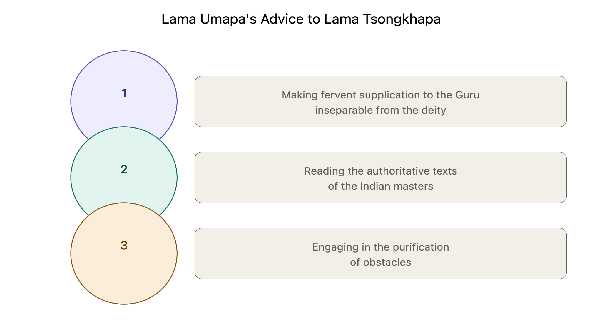
Taking this advice to heart, Lama Tsongkhapa withdrew for a period of concentrated personal practice, accompanied by only eight students. Those who were left behind could not help but feel puzzled, even a little slighted — why had they not been chosen to go? But Ārya Mañjuśrī had already anticipated this reaction. Speaking through Lama Umapa, he reassured Tsongkhapa: “If people complain, do not worry. I am the one who knows best, and it is I who am advising you to withdraw into retreat.”
And so the retreat began. At its conclusion, something remarkable unfolded in a dream. Lama Tsongkhapa saw Ārya Nāgārjuna, surrounded by a great assembly of masters — and among them stood one figure of somewhat darker complexion and sturdy build, who stepped forward and placed a folio into his hands.
The very next day, as if the dream had reached beyond sleep into waking life, a visitor arrived at Lama Tsongkhapa’s door. In his hands was a text: Buddhapālita’s commentary on Ārya Nāgārjuna’s Mūlamadhyamakakārikā. Lama Tsongkhapa began to read. And upon encountering a single verse, something shifted — the realization of emptiness he had so long sought to perfect finally dawned in his mind, complete and clear.
Also shared were:
- An anecdote from the life story of Dza Patrul Rinpoche, illustrating his exceptional humility and greatness.
- An anecdote from the life story of Dromtönpa Gyelwé Jungné, Lama Tsongkhapa’s highly realised lay student, regarded in Tibet as an emanation of Ārya Avalokiteśvara.
TOPIC: How to stop the elaborations?
Continues from yesterday…
On the Term “Elaboration”
Elaborations: Multiple Meanings
The term “elaborations” carries multiple meanings:
- Self-grasping ignorance
- Appearance of intrinsic reality, or objective reality
- Conventional truth
The word “elaboration” carries multiple connotations. One very profound connotation is “vast variety.”
Your mind is what elaborates. The mind that elaborates is self-grasping ignorance. All the elaborations of objective existence are projected by self-grasping ignorance. All these elaborations stop the moment you wake up. It is then that we discover that all of them are merely dreamlike and do not exist objectively — they are empty of objective existence.
This is not nihilism. This is dependent origination. What, then, is emptiness? It is the emptiness of objective existence.
Therefore, Āryadeva’s ‘Four Hundred Verses on the Middle Way’, Verse 180 says:
[Skt. chatuhśaṭakaśāstra nāma kārikā, Tib. bzhi brgya pa]
“Those with less merit will not even have a doubt
In this Dharma (of ultimate reality).
Should an enquiry ever arise in someone,
It will shatter Saṃsāra into pieces
Topic: What is Emptiness?
A. How to Know it correctly?
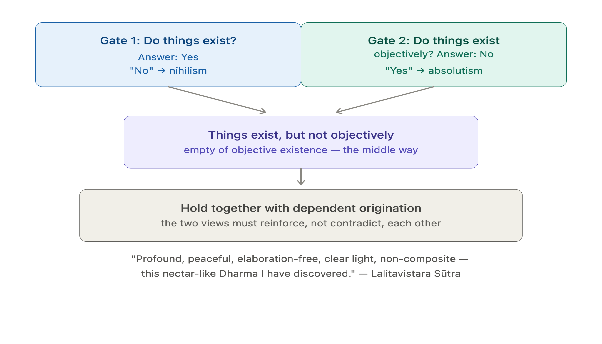
To understand this topic, one needs to pass through two gates. You ask yourself two questions:
Do things exist?
The answer should be “Yes.” If you say “No,” you fall to one extreme — nihilism. This is not emptiness.
Do things exist objectively?
The answer should be “No.” If you say “Yes,” you fall to the other extreme — absolutism. This is also not emptiness.
Only when you can pass through both gates successfully can you draw closer to understanding emptiness. Now, combine the two gates — what do you understand? Things exist, but they do not exist objectively. They are empty of objective existence.
To avoid sliding into these extremes — especially the extreme of nihilism, which may lead one into much negative karma by denigrating the functionality of things — one should always hold the understanding of emptiness alongside dependent origination. Understanding them together ensures that one does not fall into either extreme. When your understanding of emptiness and of dependent origination do not contradict each other, but instead reinforce and complement one another, you are moving in the right direction toward understanding emptiness.
These are very profound realities, requiring great care in how they are approached. It is for this reason that the Buddha remained silent for forty-nine days and did not teach after attaining enlightenment. It was only at the request of Indra, Brahmā, and the celestial beings — who entreated him to turn the Wheel of Dharma — that the Buddha began to teach.
The Buddha said in the Lalitavistara Sūtra:
“Profound, peaceful, elaboration-free, clear light, and non-composite;
Such is the nectar-like Dharma I have discovered.
Finding no one to fathom this teaching,
In silence I will retire into the woods.”
What Is Emptiness?
Make sure to know the following three statements and how they are true.
- Emptiness = A
- Dependent Origination = B
Middle Way = C
Emptiness equals Dependent Origination (A = B)
- Dependent Origination equals Middle Way (B = C)
- Emptiness equals Middle Way (A = C)
The next question is: how?
- How does Emptiness equal Dependent Origination?
Next class…
Session Three — Day Five
15 August 2026 11:30 AM – 13:30 PM
Deer Park Institute, Bir
Continues from previous session …
How Does Emptiness Equal Dependent Origination?
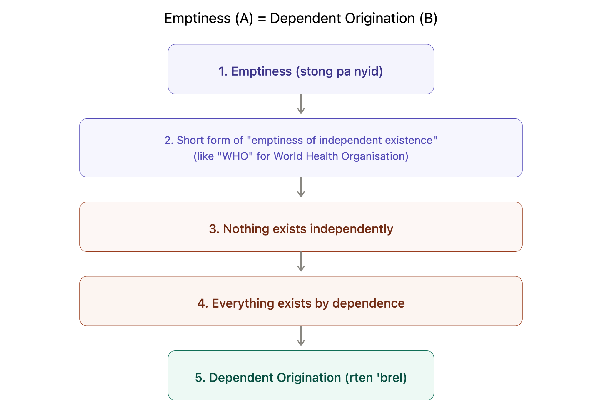
To understand how Emptiness (stong pa nyid) equals Dependent Origination (rten ‘brel), the sources provide the following five points of logical deduction:
- Emptiness (stong pa nyid)
- Short-form terminology: Emptiness is not nothingness — it is the short form of “Emptiness of independent existence.” This is comparable to using the acronym “WHO” as shorthand for the “World Health Organisation.”
- Lack of independent existence: Emptiness of independent existence means “nothing exists independently.”
- Existence by dependence: Nothing existing independently means “everything exists by dependence,” or is “dependently existent.”
- Dependent Origination (rten ‘brel): Everything existing dependently means “everything is dependently originated.”
How Does Dependent Origination Equal the Middle Way?
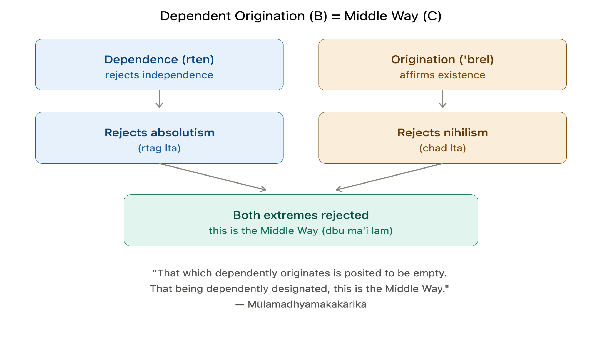
To understand how Dependent Origination (rten ‘brel) equals the Middle Way (dbu ma’i lam), the term itself contains a logic that simultaneously rejects the two extremes of existence. The logical steps are as follows:
- Dependence (rten) rejects independence: “When you say dependent, it rejects independence.”
- Independence equals absolutism: “Independence and absolutism (rtag lta) — these two mean the same.” Therefore, the “dependence” side of the term rejects the extreme of absolutism.
- Origination (‘brel) affirms existence: “When we say origination, it means something comes into origination, something comes into existence.”
- Origination rejects nihilism: This side of the term rejects “non-existence,” or “nihilism (chad lta),” because it establishes that things do indeed arise.
- Rejection of both extremes is the Middle Way: “Bringing the two together, dependent and origination together reject the two extremes. Rejecting the two extremes is following the Middle Way.”
This logic is fundamentally grounded in the famous stanza from Ārya Nāgārjuna’s Mūlamadhyamakakārikā (Fundamental Wisdom of the Middle Way):
“That which dependently originates
Is posited to be empty (of independent existence).
That being dependently designated,
This is the Middle Way.”
The Salistambha Sūtra and Its Teaching on Dependent Arising
Furthermore, the Bhagavān, the Lord of Dharma, the Omniscient One, said in the Rice Seedling Sutra:
‘Bhikṣus, whoever sees dependent arising
sees the Dharma.
Whoever sees the Dharma
sees the Buddha.’
The famous statement, “Bhikṣus (dge slong), whoever sees dependent arising (rten ‘brel) sees the Dharma (chos). Whoever sees the Dharma sees the Buddha (sangs rgyas),” originates from the Śālistamba Sūtra (Rice Seedling Sūtra; sā lu ljang pa’i mdo), where it is presented as a profound teaching on the nature of reality.
In Buddhist philosophy, particularly within the Nālandā tradition, this is explained through several interconnected layers:
To “see” dependent arising does not merely mean observing the gross physical process of a seed becoming a sprout. It means understanding that phenomena arise based on conditions, and therefore lack intrinsic existence (rang bzhin gyis grub pa).
The phrase “dependent arising” means: because this exists, that exists; because this is produced, that is produced.
Ultimately, this establishes a set of equations:
Emptiness = Dependent Origination (A = B), and
Dependent Origination = Middle Way (B = C) —
leading to the final deduction that
Emptiness = Middle Way (A = C).
This reasoning is hailed as the “king of reasoning,” because it allows the functionality and emptiness of a phenomenon to be seen as harmonious and interwoven, rather than contradictory.
His Holiness the Dalai Lama, therefore, summarised these Three Levels of Dependent Origination, drawing on his lifelong practice, study, and teaching.
The Three Levels of Dependent Origination (rten ‘brel)
The three levels of dependent origination are classified from the grossest to the subtlest as follows:
1. Causal Dependent Origination
“Dependent origination of the result’s dependence on the causes” — or, in simple terms, causal dependent origination. This level establishes that every effect is dependent on causes and conditions. It is the grossest level, and is typically the only one accepted by the lower schools (Vaibhāṣika, Sautrāntika, and Cittamātra), who apply it only to impermanent phenomena.
2. Dependent Origination of the whole’s dependence on the parts
“Dependent origination of the whole’s dependence on the parts.” This level describes how the whole cannot exist without the parts, and the parts are dependent on the whole. Unlike the first level, this is applicable to all phenomena, both permanent and impermanent.
3. Dependent Origination
of dependence on mere mental designation“Dependent origination of dependence on mere mental designation” — also referred to as “the subtlest level,” this is mental imputation (btags yod). This level teaches that things do not have any existence from their own side, independent of language, verbalisation, and mental imputation. Realising this third level is considered equivalent to understanding Emptiness (stong pa nyid).
Key Distinctions
- While the first level is confined to composite or impermanent phenomena, the second and third levels are applicable to all phenomena across the board of existence — whether permanent or impermanent.
- Requirement for Emptiness: Simply understanding the first and second versions of dependent origination does not necessarily entail understanding Emptiness; one must comprehend the third level to truly understand the Madhyamaka view.
Further, subjecting the Leaf to Ultimate Analysis to See if it exists objectively or not:
Ultimate Analysis of the Flower: The Mental “Electron Microscope”
In the process of ultimate analysis (don dam dpyod byed kyi tshad ma), the practitioner employs a mental “electron microscope” to investigate whether a flower exists from its own side (rang ngos nas), or whether it is merely a mental construct. This “zooming in” process moves through several specific anatomical and sub-atomic layers:
1. The Starting Point: Conventional Perception
The investigation begins with the flower as it appears to conventional analysis (tha snyad dpyod byed kyi tshad ma) — an analysis from a distance that does not probe the object’s mode of subsistence. To the naked eye, the flower appears as a solid, “objectively real,” and attractive entity.
2. The Mental Dissection (The “Zooming In”)
As the practitioner fine-tunes their mental perception, they move from the gross appearance to increasingly subtle levels of constituent parts:
- Surface and texture: Initially, one sees the smooth complexion of the petals, but under closer inspection, this becomes “hairy,” or appears like “cracked mud” — representing the partitions of cell membranes.
- Cellular level: The analysis moves to the level of cells, identifying the cell membrane, cytoplasm, and nucleus.
- Nuclear components: Within the nucleus, one observes chromosomes, described as “repulsive to look at, like the snake — brownish snake’s stripes.”
- Molecular level: The chromosomes are further broken down into DNA and RNA molecules.
- Atomic level: The molecules are dissected into atoms (rdul phra mo).
- Sub-atomic level: The atoms are broken down into electrons, protons, and neutrons.
- Elementary particles: The analysis can even extend to quarks.
3. The Result of the Analysis: Non-Findability
At each level, the practitioner asks the critical question: “Which of these is the flower?” This search yields the following conclusions:
- The object disappears: “The moment you go too close to this object, then the flower disappears.”
- None of the parts are the whole: At the atomic level, none of the atoms is the flower. The flower is “not one with its parts, nor is it different from its parts.”
- Failure to withstand analysis: Because the flower cannot be found under this scrutiny, it is said that the flower “cannot withstand” (bzod pa) ultimate analysis.
4. Final Philosophical Implications
- Discovery of Emptiness: What the mind finds in place of the disappeared flower is its emptiness (stong pa nyid) — specifically, the absence of objective existence.
- Subjective imputation: The flower “nobody created — it is my mind which created this flower,” through the power of mental imputation (btags yod), or conceptualization (rtog pa).
- The “Powers of Ten” analogy: The recommendation is repeatedly made to watch the NASA Powers of Ten clip as a visual aid, to understand how zooming into a leaf reveals a pool of atoms in which the “leaf-ness” is no longer findable.
Recommended to watch “Power of 10” created by NASA.
YoutTube Link: https://youtu.be/_CWb1NiLpPA
Session Four — Day Five
15 August 2026 03:00 PM – 04:30 PM
Deer Park Institute, Bir
Topics Covered:
The Third Level of Dependent Origination
3. Dependent Origination
of dependence on mere mental designation“Dependent origination of dependence on mere mental designation” — also referred to as “the subtlest level,” this is mental imputation (btags yod). This level teaches that things do not have any existence from their own side, independent of language, verbalisation, and mental imputation. Realising this third level is considered equivalent to understanding Emptiness (stong pa nyid).
For example, Flower fulfils all three levels of Dependent Origination.
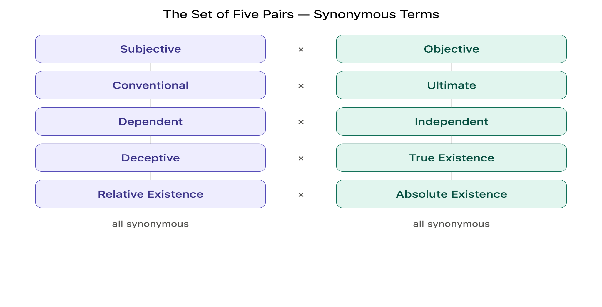
The Set of Five Pairs:
1) Subjective X Objective
2) Conventional X Ultimate
3) Dependent X Independent
4) Deceptive X True Existence
5) Relative Existence X Absolute Existence
Subjective, Conventional, Dependent, Deceptive and Relative Existence are synonymous.
Objective, Ultimate, Independent, True Existence and Absolute Existence are synonymous.
Continue exploring
The same ground, in other forms
Related by topic rather than by format — which is how a transcript, a diagram and a guided meditation on emptiness find each other.
Emptiness vs. Nihilism
A short teaching by Ven. Geshe Dorji Damdul.
Emptiness in 11 Minutes
A short teaching by Ven. Geshe Dorji Damdul.
The Wonder of Emptiness
A short teaching by Ven. Geshe Dorji Damdul.
Chittamatra and Quantum Physics
A short teaching by Ven. Geshe Dorji Damdul.