Dharma Transcripts
Wisdom of Emptiness Retreat — Day 4: 14 August 2026
Session One — Day Four Meditation Session
14 August 2026 5:45 AM – 08:00 AM
Deer Park Institute, Bir
Meditation Session
The session began with preliminary prayers, followed by the actual practice, which included:
- Śamatha Meditation — Śamatha Meditation on the Breath
- Renunciation Meditation
- Meditation to Cultivate Bodhicitta, on the basis of the Four Immeasurables
- Meditation on Emptiness
- Taking the Aspirational Bodhisattva Vows – Page 49, The Blaze of Non-dual Bodhicittas
The following verse was recited to connect us with the practice of the Wisdom of Emptiness and Bodhicitta in future lifetimes as well (Page 50, The Blaze of Non-dual Bodhicittas):
Throughout my future lifetimes,
May I always be guided by the compassionate Buddha,
And be able to uphold the two precious Bodhicittas,
Even at the cost of my life.
This was followed by a reading of the verses on the Benefits of Bodhicitta from the Bodhicaryāvatāra.
The session concluded with dedication prayers.
Session One — Day Four
14 August 2026 9:00 AM – 10:30 AM
Deer Park Institute, Bir
Topics Covered
Three Types of Suffering
- Suffering of Suffering
- Suffering of Change
- Pervasive Conditioned Suffering
1) Suffering of Suffering
This refers to any evident suffering that no one likes — pain that is universally recognized as suffering.
2) Suffering of Change
This refers to mundane, or worldly, happiness. The question then arises: how is this happiness actually a form of suffering, and why is the word “change” added to its name? It is suffering because it appear as happiness but it is actually a bait that traps you in samsāra. And, it changes into suffering of suffering. This was illustrated through the anecdote of a lady in a rented place, as well as the example of two prisoners.
3) Pervasive Conditioned Suffering
Example: The Young Terrorist Analogy Explaining Three Types of Suffering
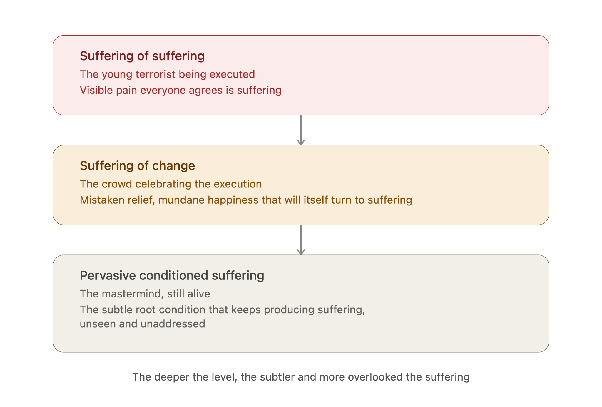
Consider the example of a young terrorist being executed, with people celebrating the event. Yet the young individual had actually been manipulated by a mastermind, who remained alive and would go on to produce more such individuals. The real target of concern, therefore, should be the mastermind himself. To understand it, one needs to know the response to three questions:
Why is Pervasive Conditioned Suffering Called Suffering?
Why is it referred to as pervasive?
Why is the word “conditioned” added to its name?
This example illustrates the Three Types of Suffering:
- Suffering of Suffering — the young terrorist (the evident, visible suffering).
- Suffering of Change — the people celebrating (mistaking a temporary, worldly satisfaction for genuine relief).
- Pervasive Conditioned Suffering — the mastermind (the underlying, root cause that continues to perpetuate suffering, unseen and unaddressed).
Prince Siddhartha and His Two Teachers
Prince Siddhartha left his two teachers, Ācārya Ālāra Kālāma and Ācārya Udraka Rāmaputra, because although they had identified the suffering of change as suffering and had reached the highest realizations attainable within saṃsāra, they had still not identified pervasive conditioned suffering as suffering. Therefore, Siddhartha left them in search of the root of pervasive conditioned suffering, and the solution to eradicate it.
What is Pervasive Conditioned Suffering?
Examples:
1. Involuntary birth in saṃsāra,
2. being under the control of contaminated karmas and afflictions,
3. contaminated aggregates,
4. contaminated neutral feelings, and
5. self-grasping ignorance.
Note: The three types of suffering differ in how hidden they are.
- Suffering of suffering: We are aware of its presence, and we also recognize it as suffering. All know them.
- Suffering of change: We are aware of its presence, but we do not recognize it as suffering. Only a few know them and therefore donot waste time and reach high level of samadhis. Like Ācārya Ālāra Kālāma and Ācārya Udraka Rāmaputra.
- Pervasive conditioned suffering: This is the most hidden of the three — we are neither aware of its presence, nor do we recognize it as suffering. Only prince sidhartha discovered it.
- Why is Pervasive Conditioned Suffering Called Suffering?
Pervasive conditioned suffering is the mastermind behind all suffering — it is the worst, most fundamental form of suffering there is. Only by gaining a genuine sense of pervasive conditioned suffering can one truly come out of saṃsāra.
The Four Noble Truths
- The Truth of Suffering
- The Truth of the Cause of Suffering
- The Truth of the Cessation of Suffering
- The Truth of the Path Leading to the Cessation of Suffering
With respect to their practice, the Buddha taught:
- The Truth of Suffering is to be identified.
- The Truth of the Cause of Suffering is to be abandoned.
- The Truth of the Cessation of Suffering is to be actualized.
- The Truth of the Path Leading to the Cessation of Suffering is to be meditated upon.
Ācārya Dharmakīrti states in the Pramāṇavārttika that when the Buddha taught that suffering is to be identified, he was referring specifically to pervasive conditioned suffering. If one has only identified the first two types of suffering — suffering of suffering and suffering of change — but remains unaware of pervasive conditioned suffering, one has not truly identified suffering at all. This is the meaning of renunciation (nge jung).
The diagram pairs each of the Four Noble Truths with its corresponding practice, as taught by the Buddha.
One should embrace whatever system genuinely helps in identifying pervasive conditioned suffering and eradicating it at its root. This is not about allegiance to any particular “-ism” or tradition — Jainism, Buddhism, Christianity, Sikhism, Hinduism, Islam, Sufism, and so forth are all profound and valuable paths. What matters is not the label one carries, but the sincerity with which one walks the path toward genuine freedom from pervasive conditioned suffering, like Prince Sidhartha did and so many are benefitted.
II. Why the word “pervasive” is added to its name?
The Three Realms of Saṃsāra
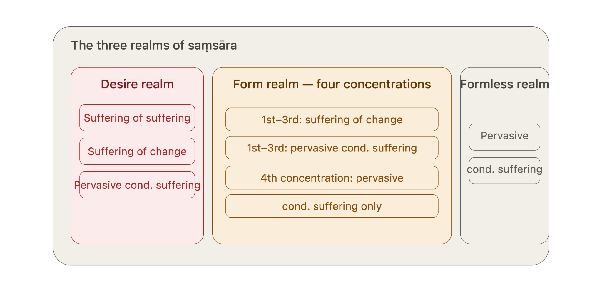
Pervasive conditioned suffering exists everywhere in saṃsāra — there is no corner of cyclic existence untouched by it. Saṃsāra itself is divided into Three Realms:
- The Desire Realm (kāma-loka)
- The Form Realm (rūpa-loka)
- The Formless Realm (arūpa-loka)
Note: Which Suffering Exists in Which Realm
- Suffering of suffering: Present only in the Desire Realm.
- Suffering of change: Present in the Desire Realm, as well as the first three concentrations of the Form Realm — the First Concentration, the Second Concentration, and the Third Concentration.
- Pervasive conditioned suffering: Present throughout all Three Realms — the Desire Realm, the Form Realm, and the Formless Realm.
Immediate Causes of the Three Types of Suffering
- Immediate Cause of Suffering of Suffering: Non-virtuous karma and non-virtuous afflictions. (Note: afflictions may not always be non-virtuous.)
- Immediate Cause of Suffering of Change: Contaminated virtuous karmas.
- Immediate Cause of Pervasive Conditioned Suffering: Self-grasping ignorance.
III. Why the word “conditioned” is added to its name?
Because it is conditioned by the contaminated karmas and afflictions.
Session Two — Day Four
14 August 2026 11:30 AM – 12:30 PM
Deer Park Institute, Bir
Topics Covered
How do we know that Pervasive Conditioned Suffering is the mastermind of all sufferings?
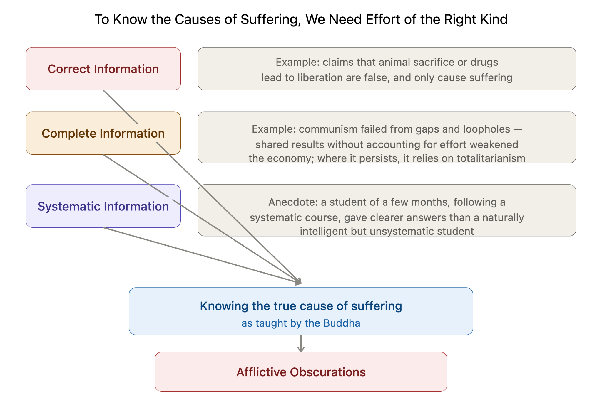
What are the causes of suffering? Everyone agrees that good results require effort — but what kind of effort matters most. There are several things we need for this.
First, we need correct information. For example, someone might claim that animal sacrifice leads to nirvana, or that drugs will liberate you. This is not correct information — it will only lead to endless suffering. So correct information is essential.
Second, we need complete information. Communism, although a good idea in principle, failed because of loopholes and gaps. If the results of people’s efforts are shared equally regardless of individual effort, many stop working hard, and the economy declines. Where communism does still function, it does so only by taking the form of totalitarianism — because some people identify the loopholes and take advantage of them. This shows that incomplete information leads to failure.
Third, we need systematic information. Here is an anecdote to illustrate this point:
There was a teaching session where questions were asked, and the answers people gave reflected their practice. One of the people present was a young girl whose answers were remarkably good. I assumed she must have been studying for many years — perhaps thirty — but she turned out to be quite young, in her twenties.
I asked her directly how long she had been studying. She said she had only recently started — she had enrolled in a systematic course of study (something like a diploma course, followed by a master’s-level course). She had been studying for only a few months, but because the course was so systematic, her understanding was well organized and her answers were precise.
I noticed a young man there as well, and asked him the same question about his answers. He acknowledged that his answers came from straining or forcing himself, because he hadn’t done any kind of systematic study. Instead, he would simply attend teachings whenever they happened, and because he was naturally intelligent, he could pick things up quickly. But without systematic study, this knowledge wasn’t well organized — he knew many things but hadn’t put them together properly.
The point of this story: natural intelligence allows one to grasp things quickly, but without systematic study, that understanding remains scattered rather than integrated.
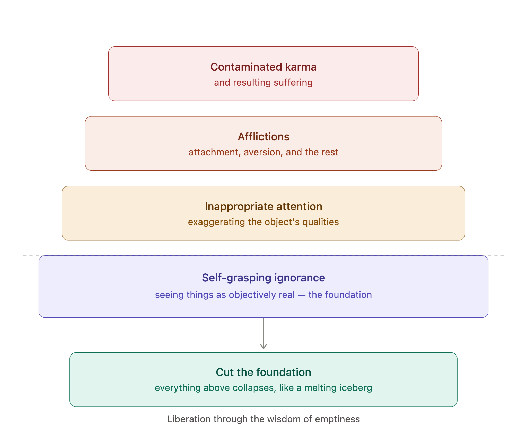
So, we must know what the causes of suffering are. And the causes of suffering that the Buddha taught are the Afflictive Obscurations.
Explanation of the Cause of Suffering / Saṃsāra: Illuminated through Verse 5, Chapter 18, Mūlamadhyamakakārikā
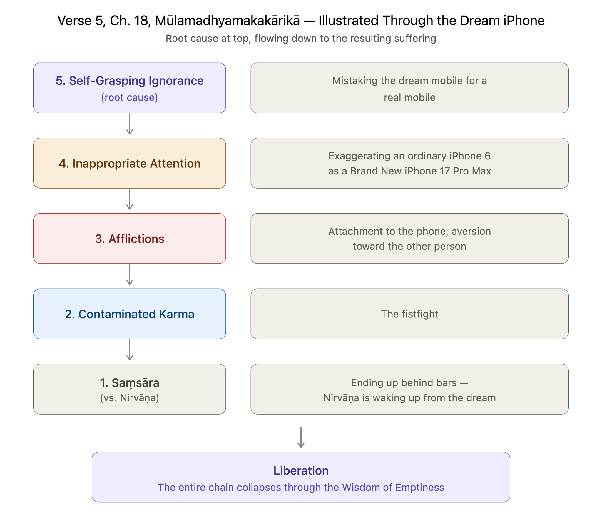
Ceasing of karmas and afflictions is liberation. Karmas and afflictions arise from conceptual thoughts. These arise from elaboration (of grasping at true existence). Elaboration ceases by (or into) emptiness.
To understand this verse, one needs to understand five points:
- Saṃsāra as opposed to Nirvāṇa
- Contaminated Karmas
- Afflictions
- Inappropriate Attention (the “conceptual thought” in the verse)
- Self-Grasping Ignorance (the “elaboration” in the verse — tröpa, or prapañca)
These five points were explained with the help of a dream example. Suppose you’re dreaming, and in the dream you see me with an iPhone. What is this? It is a dream iPhone — not an actual iPhone, but something appearing in a dream. Yet within the dream, you perceive it and say, “It’s an iPhone.”
Then, in the dream, you see a “Brand New iPhone 17 Pro Max.” Tenzin Sherab says, “May I exchange my mobile with your iPhone, Ven. Geshe-la?” Lhakpa-la also says the same. They start to have a fistfight and end up behind bars.
Now let us analyze why they suffered. The immediate cause is the fistfight — where did that come from? It came from attachment to the brand-new iPhone and aversion toward the other person who also wanted the same mobile. Why did that happen? Because you exaggerated the quality of a simple mobile phone as a Brand New iPhone 17 Pro Max — if you had seen it as only an iPhone 6, you would not have had this affliction. And why did that happen? Because you did not see the mobile as a dream mobile — you saw it as a real mobile. So this was the root cause: seeing the dream mobile as a real mobile.
Therefore, if you do not want to suffer, you should wake up. This is why “Buddha” means the Fully Awakened One — the one who has awakened from the sleep of ignorance.
Now, let us understand how suffering arises, or how saṃsāra comes into being, through the five points:
- Saṃsāra as opposed to Nirvāṇa — Being behind bars = saṃsāra; waking up = nirvāṇa.
- Contaminated Karmas — The fistfight.
- Afflictions — Attachment to the phone, aversion toward the other person.
- Inappropriate Attention — Exaggerating an ordinary iPhone 6 as a Brand New iPhone 17 Pro Max.
- Self-Grasping Ignorance — Mistaking the dream mobile for a real mobile — the root cause of it all.
Applying the Example to Real Life
Now, moving from the example to real life: the Buddha said that believing things to be objectively real is the self-grasping ignorance that triggers inappropriate attention, afflictions, and contaminated karma — giving rise to suffering, or saṃsāra.
Some Technical Points
Points 5 (self-grasping ignorance) and 4 (inappropriate attention) are also, technically, afflictions — but they are listed separately because they are subtler afflictions than the rest.
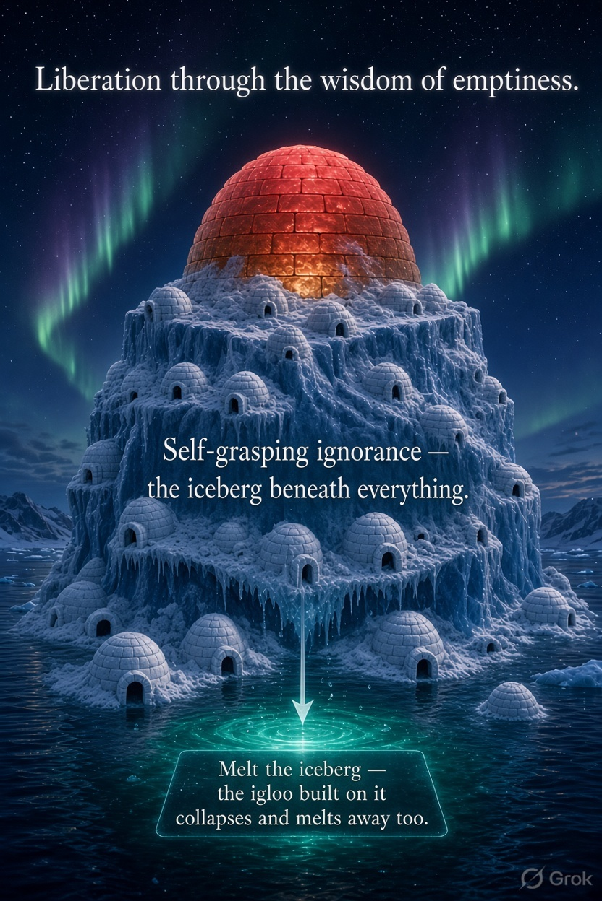
Here is how the mind actually works: seeing things as objectively real is the foundation. On top of this foundation, inappropriate attention is stacked — exaggerating the qualities of the object. On top of that, the (grosser) afflictions are stacked. Together, these three give rise to contaminated karma and suffering.
So if the root cause is cut, everything collapses — like an iceberg melting, where anything built upon it comes crashing down along with it.
This is how one can see one’s own Buddha nature: by waking up — that is, by seeing reality as it truly is, empty of objective existence, dreamlike in nature.

Session Three — Day Four
14 August 2026 03:00 PM – 05:30 PM
Deer Park Institute, Bir
The session began with a reading and reflection on the Dependent Origination and Emptiness excerpts from The Blaze of Non-Dual Bodhicitta, page 253 – compiled as per the teachings and advice rendered by His Holiness the Dalai Lama:
Dependent Origination and Emptiness: A Compilation of Excerpts from Sūtras and Treatises for Meditation on Dependent Origination and Emptiness
We should make effort to cultivate the wisdom of emptiness alongside the practice of Bodhicitta. The Buddha once compared the merit accumulated by two Bodhisattvas: one who had generated Bodhicitta many lifetimes ago but did not possess the wisdom of emptiness, and another who had generated Bodhicitta only freshly but possessed the wisdom of emptiness. The Buddha said that the second Bodhisattva accumulated far greater merit — because of the union of the two together.
Also, Saint Saraha — the teacher of Ārya Nāgārjuna, the illustrious Nālandā master — said:
Saint Sarahā’s Writings [Excerpt]
By entering into emptiness but devoid of compassion,
One will not find the supreme path.
By meditating upon compassion alone,
One will not attain liberation, but remain in Saṃsāra.
The one capable of grasping the unity of the two,
Will not remain in Saṃsāra nor abide in (personal) nirvāṇa.
Explanation of the Sadhana of Shree Hey-Ru-Ka [Excerpt]
SHREE HEY-RU-KA (x3)
HEY is the selflessness of phenomena—the emptiness of the mind which is the source of everything, as it is imputed to be of causal nature.
RU is the selflessness of person—the emptiness of the self that is fabricated by the web of conceptual thought that grasps at the self of person.
KA is the ultimate reality—the absence of the dissonant duality of subject and object.
SHREE is the non-dual exalted wisdom that abides in congruence with the emptiness of the object.
This is the meaning of AY-WAM
Śrī Heruka, is the name of a Buddha. The Buddha manifests differently at times to help sentient beings according to their predispositions. To know all sentient beings and help them accordingly, one needs omniscience. When Buddhas choose their names, they do so such that when one contemplates the meaning of the name, one is benefited.
Whenever we feel sad or in pain, two things are involved: the self (I) and phenomena. We interact with the phenomena, and sadness arises. This does not happen in the case of the Buddhas. This means there is a third factor involved in our case of interaction — namely, self-grasping ignorance. So we have to remove both the self-grasping ignorance of self (I) and the self-grasping ignorance of phenomena.
Seeing the dreamlike self and phenomena as real — that is saṃsāra. What is a dream? A dream is purely subjective; it is not objective.
Three points pertaining to Saṃsāra:
- Seeing the dream-ghost as real is ignorance.
- Seeing the dream-ghost as real happens within the dream.
- Seeing the dream-ghost as real — the outcome is fear. That is saṃsāra.
Three points pertaining to Nirvāṇa:
- Seeing the dream-ghost as a dream is wisdom.
- Seeing the dream-ghost as a dream happens upon waking up.
- Seeing the dream-ghost as a dream — the outcome is relief. That is nirvāṇa.
Dream meaning it is purely subjective — it is not objective. So when you objectify self and phenomena, that is the self-grasping ignorance (SGI) of self and of phenomena. This is duality.
But when you see the emptiness of the objectivity of phenomena, the solidification of phenomena dissolves. This is HE.
When the objectification of phenomena dissolves, only one is left. Some call this non-duality, because only one remains — as in many philosophical traditions, such as Advaita Vedānta, or some Western philosophers like René Descartes. But this is not the non-duality as posited in Madhyamaka Buddhism.
Along with this, the solidification of the self also dissolves — when you see the emptiness of the objectivity of the self. This is RU.
Non-duality (Madhyamaka) — when both the objectification of self and the objectification of phenomena dissolve, that is the non-duality that Madhyamaka posits.
Now, what remains is this non-duality itself. So when you see the emptiness of the objective existence of this non-duality, that is KA.
Now, who knows this? My non-dual wisdom knows it — even that non-dual wisdom is non-dual with the non-duality it knows. This is ŚRĪ.
There are three choices before us:
- An unpleasant dream
- A pleasant dream
- Waking up
We would all prefer the third option. What the first and second have in common is that in both cases, we remain within the dream and have no freedom. The unpleasant dream is the suffering of suffering; the pleasant dream is the suffering of change. Both are dictated by the very fact of being in the dream — which is the mastermind, the pervasive conditioned suffering underlying both.
So when you wake up, nothing of the unpleasant dream or the pleasant dream can affect you any longer. That is liberation.
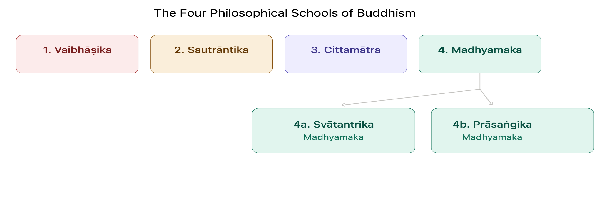
The Four Philosophical Schools of Buddhism
- Vaibhāṣika
- Sautrāntika
- Cittamātra
- Madhyamaka: 4a. Svātantrika Madhyamaka & 4b. Prāsaṅgika Madhyamaka
Exercise to Understand How Waking Up from a Dream Leads to Relief
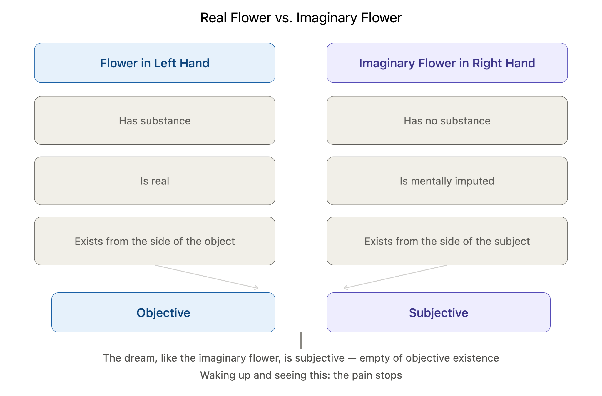
Consider the flower in my left hand and the imaginary flower in my right hand. What are the differences between them? It has many differences.
- The flower in my left hand has substance; the imaginary flower in my right hand has no substance.
- The flower in my left hand is real; the imaginary flower in my right hand is merely mentally imputed.
- The flower in my left hand exists from the side of the object; the imaginary flower in my right hand exists from the side of the subject.
From these three points, we learn that the flower in my left hand is objective, while the imaginary flower in my right hand is subjective. The imaginary flower being subjective means it is empty of objective existence.
The dream is likewise subjective. This means that when you wake up from the dream, you realize that the dream was subjective, not objective — it is empty of objective existence. And with this realization upon waking up, the pain stops.
How to See Everything as Dreamlike, or Empty of Objective Existence?
How to See Emptiness: The Metaphor of the Four Stages
- Whitish waves — when they subside. This is the metaphor for contaminated karmas, such as the ten non-virtuous karmas explained earlier. One should put effort into stopping them as much as possible.
- Bubbles — when they subside. This is the metaphor for gross afflictions, such as attachment, anger, and jealousy. Try to minimize them — for example, before enjoying a piece of cheesecake, try to reflect on its impermanence and emptiness.
- Sand particles — when they subside. This is the metaphor for inappropriate attention.
- The current of the water — when it subsides. One cannot see this with one’s eyes, but it still affects the water. This is the metaphor for self-grasping ignorance.
- The clarity of the water manifests. This is the metaphor for seeing emptiness.
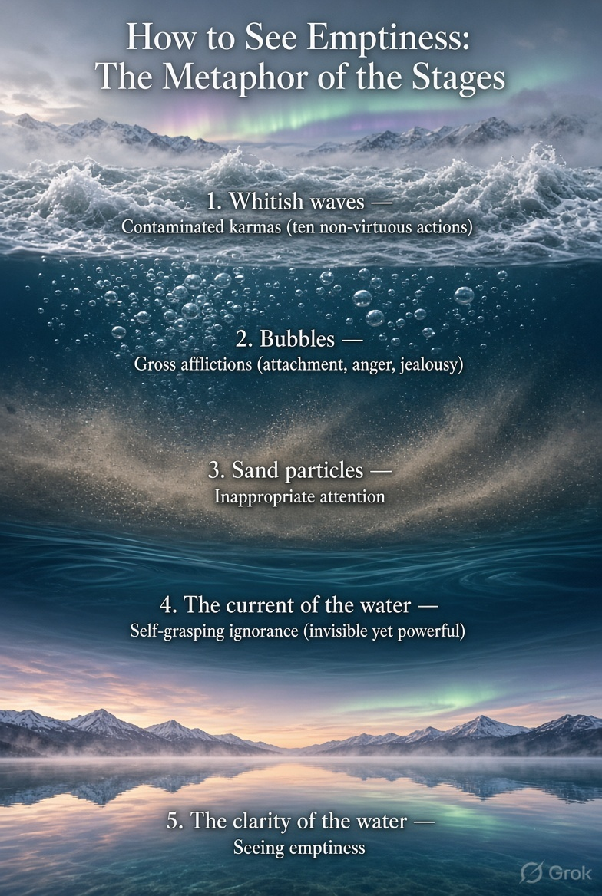
How to stop the elaborations?
Will continue tomorrow…
Continue exploring
The same ground, in other forms
Related by topic rather than by format — which is how a transcript, a diagram and a guided meditation on emptiness find each other.
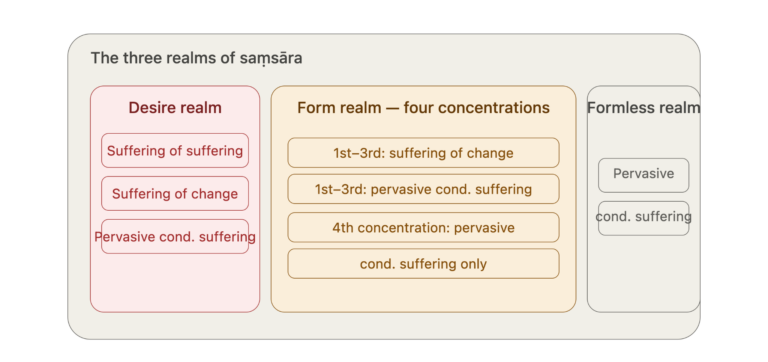
Which Suffering Exists in Which Realm
Suffering of suffering: Present only in the Desire Realm. Suffering of change: Present in the Desire Realm, as well as…
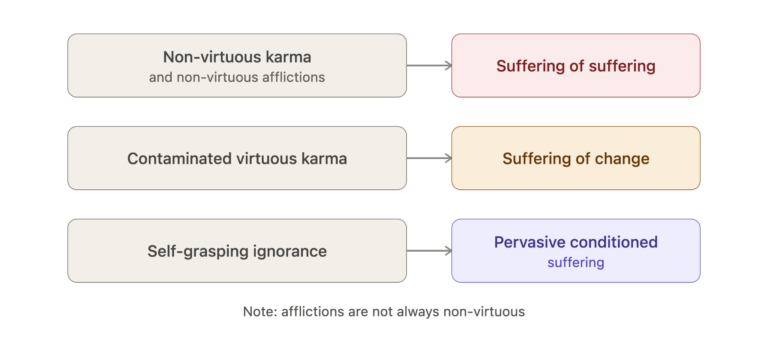
The Immediate Causes of the Three Types of Suffering
**Immediate Cause of Suffering of Suffering: Non-virtuous karma and non-virtuous afflictions. (Note: afflictions may not always be non-virtuous.) **Immediate Cause…
Vipaśyanā Meditation on Renunciation
Reflecting on the Four Seals, fostering inner freedom.
The Four Noble Truths
The Truth of Suffering The Truth of the Cause of Suffering The Truth of the Cessation of Suffering The Truth…