Dharma Transcripts
Wisdom of Emptiness Retreat — Day 2: 12 August 2026
Session One — Day Two Meditation Session
12 August 2026 5:45 AM – 08:00 AM
Deer Park Institute, Bir
- Significance of Daily Meditation: The importance of maintaining a regular meditation practice.
- Explanation of the Verse from Abhisamayalankara: The three types of beings, their aspired goals, and the three factors required to attain those goals — known as the Three Mothers.
- Two Types of Meditation: Single-Pointed Meditation and Analytical Meditation.
- Shamatha and Vipashyana: Calm abiding and special insight.
Session One — Day Two
12 August 2026 9:00 AM – 10:30 AM
Deer Park Institute, Bir
Topics Covered
- Buddha Nature (Tathagatagarbha): Introduced the concept of Buddha nature as the potential for perfection present in every sentient being.
- Rational Conviction: Explained the reasoning behind why we can confidently recognize that we — and all sentient beings — possess this potential for perfection, moving it from belief to reasoned conviction.
- Manifesting Buddha Nature: Discussed practical approaches to actualizing this potential through three kinds of wisdom.
- Luminous Nature of Mind: Unpacked the verse from Acharya Dharmakirti’s Pramanavarttika — “the true nature of mind is luminous; mental defilements are adventitious”
- Samsara vs. Nirvana: the distinction between samsara and nirvana. Samsara is the lack of freedom to expand your mind. Nirvana is freedom to expand your mind.
- Two Types of Buddha Nature: Explained the distinction between Proliferating Buddha Nature (the mind of the sentient beings that can transform to become awakened mind) and Natural Buddha Nature (ultimate truth of the proliferating Buddha nature).
- Two Goals We Seek: Nirvana — fearlessness — and Buddhahood — infinite happiness and peace. We have the potential to attain both because we possess Buddha nature. To realize this potential, the Buddha nature must be freed from two obscurations that prevent us from attaining these two goals.
- Two Obscurations: Afflictive Obscurations and Cognitive Obscurations.
- Afflictive Obscurations: The obscurations that prevent us from attaining nirvana, or fearlessness. They comprise three: Contaminated Karmas, Afflictions, and the active seeds of the two.
Session Two — Day Two
12 August 2026 11:30 AM – 12:30 PM
Deer Park Institute, Bir
Topics Covered
- Two Obscurations: Afflictive Obscurations and Cognitive Obscurations.
- Afflictive Obscurations: The obscurations that prevent us primarily from attaining nirvana, or fearlessness. They comprise three: Contaminated Karmas, Afflictions, and the active seeds of the two.
Contaminated Karmas – It includes the Ten Non-Virtuous Actions. Refraining from them are as follows:
No Killing, No Stealing, No Sexual Misconduct;
No Lying, No Slandering, No Harsh Words, No Idle Gossip;
No Covetousness, No Ill Will, No Wrong View
(Reference material to study more on this topic – “The Treatises on the Stages of the Path to Enlightenment” by Lama Tsongkhapa; “The Words of My Perfect Teacher by Patrul Rinpoche)
Affliction: the mental factor, the presence of which disturbs the mind. - Cognitive Obscurations: The obscurations that prevent us from attaining Buddhahood, or omniscience. These are illustrated through the example of the lingering smell of garlic in a mug even after it has been removed – the smell persists as a subtle residue. Cognitive obscurations are similarly subtle, in contrast to afflictive obscurations, which are grosser.
- Inferring Their Presence: How do we know we have cognitive obscurations? Their existence can be inferred from the presence of afflictive obscurations, among other reasons.
- A Note for Later Study: The precise meaning of cognitive obscurations will be studied on Day Four or Day Five.
- The Pursuit of True Well-Being: Those who work hard and put in effort for their own well-being are considered wise. The highest form of well-being is attained by removing mental defilements — the two obscurations.
- The Path to This Goal: To achieve this, the Buddha taught the Three Turnings of the Wheel of Dharma.
- Understanding the Three Turnings: To understand each turning, we need to know three things: the Place, the Target Audience, and the Subject Matter.
The First Turning of the Wheel of Dharma
- Place: Sarnath
- Target Audience: Vaibhashika and Sautrantika
- Subject Matter: The Four Noble Truths and that they exist truly.
The Second Turning of the Wheel of Dharma
- Place: Vulture Peak, Rajgir
- Target Audience: Madhyamaka
- Subject Matter: Nothing exists truly; the teaching of the emptiness of self-characteristics.
The Third Turning of the Wheel of Dharma
- Place: Vaishali
- Target Audience: Cittamātra
- Subject Matter: Good Differentiation
The Account of the Third Turning of the Wheel of Dharma
During the Third Turning, ten Bodhisattvas each rose to ask the Buddha a different question, one after another. Among them, the Bodhisattva Paramārthasamudgata stood up and posed his question to the Buddha.
Continues in the afternoon …
Session Three — Day Two
12 August 2026 02:30 AM – 04:00 PM
Deer Park Institute, Bir
Topics Covered
The Third Turning of the Wheel of Dharma
- Place: Vaishali
- Target Audience: Cittamātra
- Subject Matter: Good differentiation
The Account of the Third Turning of the Wheel of Dharma
During the Third Turning, ten Bodhisattvas each rose to ask the Buddha a different question, one after another. Among them, the Bodhisattva Paramārthasamudgata stood up and posed his question. Though he himself had no doubt, he asked on behalf of the Cittamātrins: the teachings of the two earlier turnings appeared contradictory, yet the omniscient cannot hold any contradiction — kindly explain. The response to all questions belong to the Third Turning but the Buddha’s response to this question asked by the Bodhisattva Paramārthasamudgata specifically constitutes the subject matter of the Third Turning because it it particularly asked about the first two turnings.
To understand this response, one must first understand that anything that comes to mind is either existent or non-existent. If existent, it is either permanent or impermanent. Permanent phenomena are further divided into two: (1) ultimate truth, and (2) permanent phenomena other than ultimate truth.
Thus, everything that can come to mind, without further division, falls into four categories:
- Non-existent
- Impermanent phenomena
- Ultimate truth
- Permanent phenomena other than ultimate truth
The Three Natures
On the other hand, there are Three Natures:
- Imputed Nature
- Other-Powered Nature
- Thoroughly Established Nature
Correlating the two, the following arrangement arises:
- Non-existent and Permanent Phenomena other than ultimate truth fall into Imputed Nature.
- Impermanent Phenomena is synonymous with Other-Powered Nature.
- Ultimate Truth falls into Thoroughly Established Nature.
Of the three natures, Thoroughly Established Nature and Other-Powered Nature are the two that exist truly, while Imputed Nature does not exist truly – it is the least true, or least real, of the three.
This same framework can then be applied to reconcile the First and Second Turnings of the Wheel of Dharma: what the First Turning describes that the Four Noble Truths as existing truly corresponds to Other-Powered Nature and Thoroughly Established Nature, while what the Second Turning describes as not existing truly corresponds to Imputed Nature. This is the Response.
The Important Statement that makes the bedrock of Cittamātra philosophy:
The Other Powered Nature being empty of the Imputed Nature is the Thoroughly Established Nature
The flower, i.e. Other-Powered Nature, is empty of external reality, i.e., Imputed Nature – constitutes the Emptiness of External Reality of the flower, i.e., Thoroughly Established Nature.
Foundational Philosophy of Cittamātra – All phenomena are the nature of mind like in the dream. Nothing exists external to mind. What appears as external to mind is illusory and does not exist truly.
Involuntary Pull – attachment
Involuntary Push – Aversion
Samsara is a cycle of Involuntary Pull and Push.
When you see momo is empty of external reality and just the nature of your mind, the Involuntary Pull and Push stop. It is your freedom.
- The Four Seals of the Buddha’s Teachings:
All composite things are impermanent.
All contaminated things are of the nature of suffering.
Everything is of the nature of emptiness and selflessness
Transcending sorrow is absolute peace.
These four lines are metaphorically sealed by the Buddha. Anyone who wishes to end suffering must practice these four seals without exception.
- All composite things are impermanent: Composite things are those composed of material or temporal parts – temporal parts meaning parts existing in time.
The Buddha did not state that everything is impermanent; rather, he stated that only composite things are impermanent. Non-composite phenomena are not impermanent – they are permanent. An example of this is the permanent phenomena other than ultimate truth that we studied earlier. Discuss examples with reasons in group discussion.
Continue exploring
The same ground, in other forms
Related by topic rather than by format — which is how a transcript, a diagram and a guided meditation on emptiness find each other.
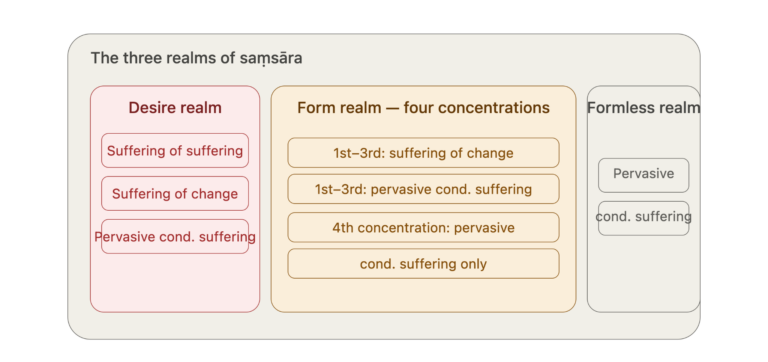
Which Suffering Exists in Which Realm
Suffering of suffering: Present only in the Desire Realm. Suffering of change: Present in the Desire Realm, as well as…
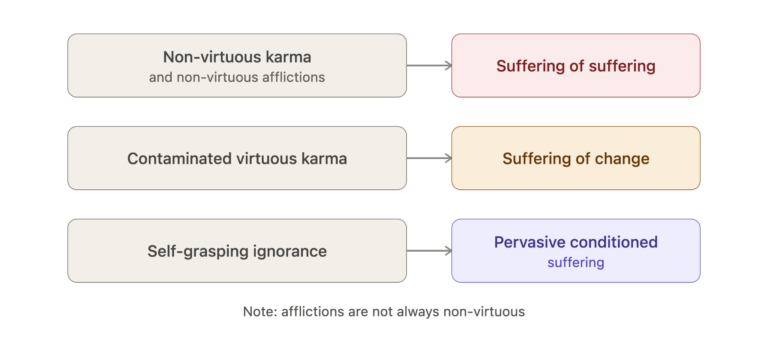
The Immediate Causes of the Three Types of Suffering
**Immediate Cause of Suffering of Suffering: Non-virtuous karma and non-virtuous afflictions. (Note: afflictions may not always be non-virtuous.) **Immediate Cause…
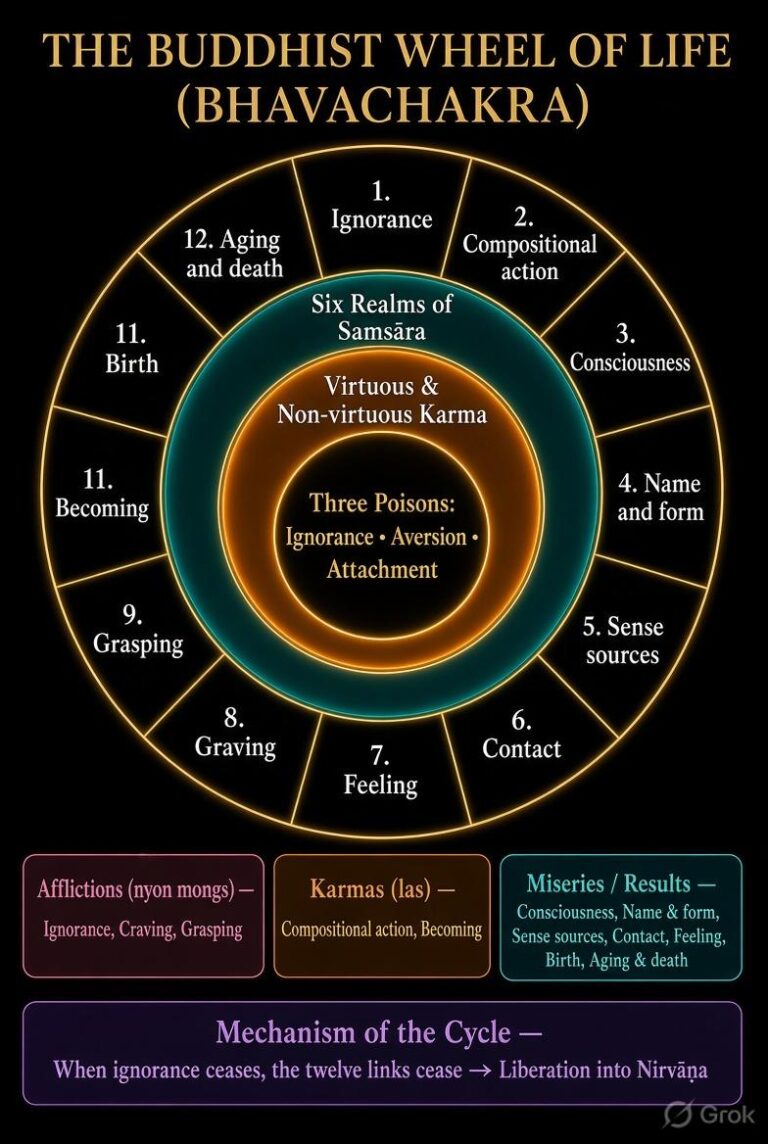
The Wheel of Life: the Twelve Links of Dependent Origination
The Wheel of Life (srid pa’i ‘khor lo) is “precisely, the teaching on The Twelve Links of Dependent Origination (rten…
The Second Children’s Dharma Retreat, Deer Park 2026
A morning of questions and answers with the children of the Tibetan Children's Villages on the Buddha, the Three Jewels,…